This is the next post in Plan Proponent’s series on the confirmation-related recommendations in the ABI Commission Report (and, in particular, its Exiting the Case piece). We addressed Part A (section 1 and section 2) and Part B in prior posts. Part C (“Value Determinations, Allocation, and Distributions”) is more involved. Therefore, we’ll tackle it over a few posts, with this post kicking-off Part C.1: “Creditor’s Rights to Reorganization Value and Redemption Option Value.”

The Commission starts with the general observation that bankruptcy law evaluates creditor rights, with state law, the Fifth Amendment to the Constitution, and the Constitution’s Bankruptcy Clause, among other things, informing that evaluation. In particular, the Fifth Amendment, with its emphasis on property and due process, often collides, whether explicitly or implicitly, with valuation issues in bankruptcy, leading courts and practitioners to adopt different views on what it means to value a “secured creditor’s interest in the debtor’s interest in property.”

The most cited valuation concept in Chapter 11 is the rule in Section 506(a) that

value shall be determined in light of the purpose of the valuation and of the proposed disposition or use of such property, and in conjunction with any hearing on such disposition or use or on a plan affecting such creditor’s interest.

With that in mind, the Commission splits secured claim valuation into at least 3 issues:

  • What is the appropriate valuation standard for the secured creditor’s collateral?
  • What is the appropriate valuation standard to determine the secured creditor’s interest in the collateral?
  • What is the appropriate valuation methodology for valuing the collateral?

The 3-prong valuation issue lends itself to uncertainty and, thus, litigation and/or compromise.

In the Chapter 11 plan context, if compromise or consensus is not possible, then the intersection of the “absolute priority rule” and valuation can bar a successful reorganization or leave junior creditors out of the money. We introduced the absolute priority rule here, with an emphasis on individual debtors, but it applies anytime a plan proponent must seek plan confirmation via “cramdown” under Section 1129(b) (i.e., when there is at least one dissenting class of creditors). Dating back to the 19th century, the absolute priority rule was and is intended to “prevent deals between senior creditors and equity holders that would impose unfair terms on unsecured creditors.” See Friedman v. P + P, LLC, 466 B.R. 471, 478 (9th Cir. B.A.P. 2012) (internal citations omitted).

For secured claims, the Commission summarizes the absolute priority rule this way: “secured creditors have a right to receive payment in full prior to junior creditors and interest-holders receiving any value” (but see comment below). A concern of the Commission, which it addresses in its recommendations (which we’ll cover in a later post), is that the timing of the collateral valuation can cause junior creditors to “lose their rights against the estate and receive no value on account of their claims.” Meanwhile, secured creditors, who might otherwise be limited to foreclosure outside of bankruptcy, can get the benefits, if not the exclusive benefits, of the Chapter 11 case and the debtor’s going concern value. The Commission addressed a similar valuation/distribution concern in the Section 363 sale context.

Therefore, the Commission explores in Part C the rights of secured creditors and how to “best balance those rights with the reorganization needs of the debtor and the interests of the other stakeholders.” We’ll pick up next time with some of the Commission’s recommendations on valuation, in light of the above concerns.

[As an aside, does the absolute priority rule mean that a plan proponent cannot pay a dime to junior creditors and interest-holders until senior creditors are paid in full or just that senior creditors must be provided for in full? This author is not aware of anything in the Code that prohibits a plan proponent from proposing to pay a senior creditor in full over time while also making payments to a junior class in the interim, with or without consent. However, some practitioners rely on cases like Bank of Am. NT & SA v. 203 N. Lasalle St. P’ship, 526 U.S. 434 (1999) (addressing whether there is a “new value” exception to the absolute priority rule) to argue that senior claimants must receive payment in full before junior claimants can participate in a plan.]
This is the next post in Plan Proponent’s series on the confirmation-related recommendations in the ABI Commission Report (and, in particular, its Exiting the Case piece). Part B of the “Exiting the Case” piece is titled “Approval of Section 363x Sales.”

Acknowledging various concerns raised by courts about Section 363 sales, the Commission considered the extent to which Section 363 sales should be subject to the rigors of the plan process. Although Part B is most notable for the Commission’s recommendations (listed below), the background provided by the Commission about Section 363 issues is also useful.

First, Part B is just one of many sections of the Report addressing the sale of all or substantially all of a debtor’s assets under Section 363(b) of the Code.

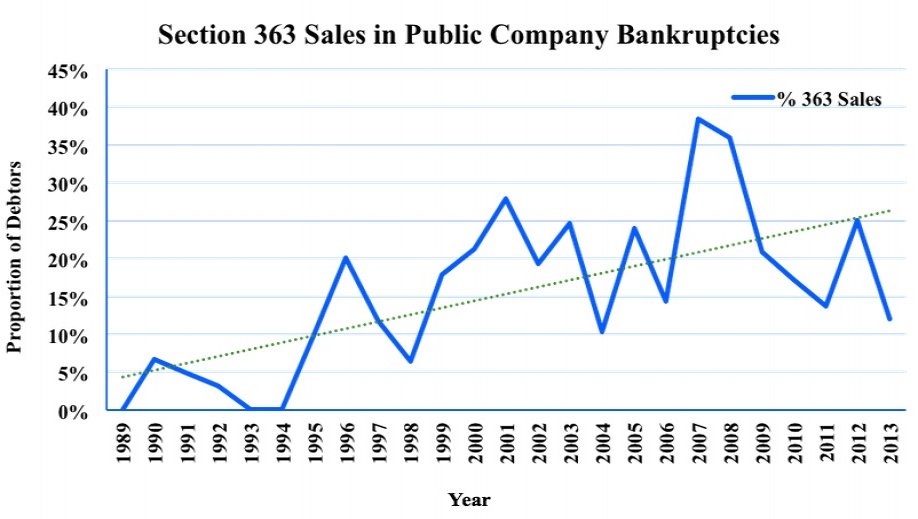
Second, the Commission attempts to introduce empirical data regarding 363 sales in Chapter 11. However, it warns that such data is limited, mixed, and difficult to interpret. Not only is it difficult to “code” the data as reflecting a “liquidation, going concern sale (i.e., section 363x sale), or confirmed plan,” but it is also difficult to “collect and code creditors’ recoveries.” In fact, the Commission suggests that much of the data is from large Chapter 11 cases, only (i.e., cases involving assets of $100 million or more). Finally, the Commission warns that dockets and, thus, the data, rarely reflect the unique dynamics that drive a particular case. With those caveats in mind, the Commission supplied the following chart:

363 salesThird, the Commission identifies the concerns that some courts have raised regarding Section 363 sales, particularly those sales that involve a sale of all or substantially all of a debtor’s assets:

  • Potential avoidance of notice and due process;
  • Pursuit of a fast-track process before parties-in-interest can obtain adequate information;
  • Insufficient time for parties-in-interest to identify restructuring alternatives;
  • Determination of ultimate creditor distributions without voting and other plan protections;
  • Sale timing issues that can impact, if not chill, asset values and, thus, diminish recoveries; and
  • Additional potential impacts on asset values due to abbreviated marketing periods.

Fourth, and in light of the above concerns, the Commission considered the extent to which a sale of all or substantially all of a debtor’s assets is tantamount to a reorganization. After all, such sales can result in a change in control, result in final creditor distributions, and position the debtor to continue in business in another form. The Commission concluded that such sales justify incorporating some of the plan protections under Section 1129. See below.

[The above concerns often come to a head in cases addressing whether a 363 sale is, in fact, a “sub rosa” (de facto) plan. See, e.g., In re Gen. Motors Corp., 407 B.R. 463 (Bankr. S.D.N.Y. 2009).  Steve Jakubowski had a good post about 363 sales and sub rosa plans on his Bankruptcy Litigation Blog. See also Reginald Jackson’s 2010 article for the Southeastern Bankruptcy Law Institute (the pride and joy of the Georgia Bankruptcy Bar.)]

Fifth, the Commission emphasized how the typical standard of review for a Section 363 sale differs from the standard of review applied to a plan under Section 1129. The typical standard of review for a 363 sale is a business judgment rule approach, which looks for a good business reason for the sale and might impose some heightened scrutiny. Arguably, the standard for plans is  much stricter, and demands a vote, good faith, satisfaction of the best interests of creditors test under 1129(a)(7), payment of certain administrative claims, no unfair discrimination, and “fair and equitable” treatment of dissenting creditors.

Ultimately, the Commission concluded that the 363 sale process should protect creditors in the same way that the 1129 plan process protects creditors.

With that in mind, the Commission made the following Recommendations for Section 363 sales:

  • Sale should be in the best interests of the estate by a preponderance of the evidence;
  • Sale should comply with provisions that are comparable to the 1129 plan requirements;
  • Sale and sale proponent should comply with the applicable provisions of the Code;
  • Sale should be proposed in good faith and not by any means forbidden by law;
  • Sale-related costs and expenses should be reasonable;
  • Administrative-type claims (through the sale date) should be paid/resolved;
  • Statutory bankruptcy fees should be paid at or before closing;
  • There should be adequate notice and an opportunity to be heard by all parties-in-interest impacted by proposed purchaser protections.

Additionally, the Commission incorporates its 363-related recommendations from other parts of the Report, including:

  • Section VI.G (Orders Resolving Chapter 11 Case – Exit Orders) (we’ll cover that separately in our series)
  • Section IV.C.2 (Timing of Section 363x Sales) (recommending a 60 day sale moratorium)
  • Section V.B (Use, Sale, or Lease of Property of the Estate) (i.e., non-ordinary course transactions)

In our next post on the ABI Commission Report, we will address the first portion of Part C (“Value Determinations, Allocation, and Distributions”).


This is the next post in Plan Proponent’s series on the confirmation-related recommendations in the ABI Commission Report (and, in particular, its Exiting the Case piece). Part A of that piece is titled “General Authority of Debtor in Possession and its Board of Directors.” The second section of Part A (and this post) addresses the role of the debtor in the plan process. We addressed the first part (the debtor’s authority in the plan process) here.

Debtor v. Debtor-in-Possession in the Plan Process

The second section addresses the distinction, if any, between a debtor and a debtor-in-possession when it comes to fiduciary duties. After all, Section 1121 of the Code refers to the “debtor” having the right to file a plan–not the debtor-in-possession. Does the debtor, as plan proponent, owe fiduciary duties under the plan-related Code sections (e.g., 1121, 1127, 1129, 1141, 1142, etc.) in the same manner that the debtor-in-possession owes fiduciary duties to the estate?

The Commission points out that some courts have determined that a plan proponent does not owe fiduciary duties in the plan process. Seee.g., In re Waters Edge Ltd. P’ship, 251 B.R. 1, 7 (Bankr. D. Mass. 2000) (finding that a plan proponent’s “bargaining and cramdown rights necessarily exclude” fiduciary obligations, including any duty of loyalty to unsecured creditors). It points out that other courts find that the debtor-in-possession’s fiduciary duties continue to apply in the plan process. And, finally, other courts are not very precise on the issue either way.

Ultimately, the Commission recommends that Section 1121 should be amended to clarify that the “debtor should be separated from the debtor in possession in the plan context, and that the debtor acting as plan proponent should not be considered a fiduciary for the creditors.”

The Commission reasons that it would be difficult, if not impossible, for a plan proponent to negotiate a plan for itself and its equity security holders, on the one hand, and negotiate a plan in satisfaction of the debtor-in-possession’s fiduciary duties to creditors, on the other hand. And although the Commission considered novel proposals for choosing, clarifying, or determining a plan proponent’s fiduciary duties, the Commission fell back on the state law deference that we discussed in the previous post:  applicable state governance law should determine a plan proponent’s fiduciary duties in “negotiating, drafting, and seeking confirmation of a chapter 11 plan.”

Refresher on Fiduciary Duties In and Out of Bankruptcy

Although other resources are likely better-equipped to fully address management’s state law fiduciary duties (and the continuing evolution of the law in that area), Plan Proponent will attempt to supply  a high-level refresher.

First, most states recognize that directors and officers, or similar managers, have a duty of loyalty and a duty of care to the corporation. Under the duty of care, management must exercise ordinary care and prudence under the circumstances and act in good faith and in the best interests of the corporation and its shareholders. Under the duty of loyalty, management must refrain from self-dealing and avoid conflicts of interest and even the appearance of impropriety.

Second, under the business judgment rule, if management acts in good faith, on an informed basis, and in a manner that it reasonably and honestly believes is in the corporation’s best interests, then there is a strong presumption in favor of respecting managerial actions. Ultimately, the business judgment rule focuses more on the decision-making process than the decision itself. It provides a sort of safe harbor for duty of care questions, but not duty of loyalty questions.

[Note: Courts have struggled for the last 20 years to determine whether those duties change as a business entity approaches insolvency (the “zone of insolvency”) and/or when it becomes insolvent. The better view appears to be that approaching insolvency or becoming insolvent does not change the nature of the duties. Rather, it becomes a question of who are the beneficiaries of the duty (i.e., the community of interests served by the duties expands to include and provide standing to creditors). At bottom, it still appears that managers simply need to maximize or preserve the long-term going concern value of the entity in good faith and on an informed basis.]

Generally, these duties and the business judgment rule continue to apply in Chapter 11 even though (i) a debtor-in-possession’s management is, by definition, not disinterested and (ii) Chapter 11 presents a “turbulent rivalry of interests.”  See 7-1108 Collier on Bankruptcy P 1108.10 [5] (16th ed.) (quoting In re Curlew Valley Associates, 14 B.R. 506, 510 (Bankr. D. Utah 1981)).

Therefore, current practice and the Commission appear to agree with the following general proposition: In Chapter 11, management can (and, arguably, is expected to) continue to seek profit for shareholders, even with some risk, so long as it acts with due care, without self-dealing or bad faith, and while considering the prospects of reorganization and the need for support from one or more constituencies. All constituencies should be considered, but not all constituencies have to be in agreement.

Arguably, that rule is particularly appropriate because (i) the Code has such a preference for the continuation of interested and potentially conflicted management; (ii) the Code provides additional checks and balances via Sections 1102 and 1109 (i.e., creditor and equity committees and the general right to be heard); and (iii) the Code provides an ultimate backstop via bankruptcy court scrutiny.

As an aside, a financial advisor who we routinely engage in Chapter 11 cases often refers to the equity class in a plan as the “good news class,” the idea being that so long as bankruptcy’s priority scheme (including the absolute priority rule) is satisfied, maximizing a debtor’s profit and going concern value almost naturally guarantees that creditor constituencies are being taken care of in an optimal fashion.

[For the avoidance of any doubt, the Commissioners also determined that requiring separate professionals for the debtor, on the one hand, and the debtor-in-possession, on the other hand, would likely be duplicative and costly, with no real advantage, so long as the subject professionals were otherwise disinterested under Sections 327 or 328.]

In our next post on the ABI Commission Report, we will address “Approval of Section 363x Sales.”

SHMeeting

This is the next post in Plan Proponent’s series on the confirmation-related recommendations in the ABI Commission Report. Click here for the Introduction. Over the next 2 months, Plan Proponent will dig into the Exiting the Case piece of the Report. Part A is titled “General Authority of Debtor in Possession and its Board of Directors.” The first section of Part A (and this post) addresses the authority of the debtor, generally, and in the plan process, specifically.

Generally, the Bankruptcy Code defers to state law and entity governance documents on the issue of corporate authority for a Chapter 11 debtor’s board of directors, officers, and managers. However, the scope of that deference is not always clear. Therefore, the Commission evaluated that deference in 3 contexts: (1) annual shareholder meeting demands; (2) Section 363 sales; and (3) Chapter 11 plan proposals under Section 1123(a)(5) of the Code.  The issue:

To what extent does or should the Bankruptcy Code preempt corporate governance under state law, either expressly or practically?

Put another way, assume that the above annual meeting snapshot depicts the typical shareholder scene at an annual meeting. What role does Chapter 11 give those shareholders, if any, in administering a Chapter 11 case? Does the Bankruptcy Code, without anything further, preempt their state law authority to determine corporate policy?

With annual shareholder meetings, the issue is whether shareholders have a right in Chapter 11 to shareholder meetings that might otherwise be required outside of Chapter 11. The Commission observes that bankruptcy courts usually do not interfere with a shareholders’ rights to demand annual meetings, elect directors, and, thus, control corporate policy unless their exercise of those rights amounts to a “clear abuse” of the process or is at odds with the bankruptcy estate’s interests. Although the Commission recognizes the potential for abuse, additional expense, and delay in respecting meeting demands, it recommends that those demands be left to the courts on a case-by-case basis.

With Section 363 sales, the issue is whether the Bankruptcy Code preempts or should preempt any state law or organizational document requiring shareholder approval for sales of all or substantially all of a debtor’s assets. Bankruptcy courts commonly authorize Section 363 sales without requiring shareholder approval, primarily to avoid delay, uncertainty, and shareholder abuse. Additionally, the Commission points out that shareholders can object under Section 363 and Section 1109 (which provides all parties-in-interest the “right to be heard” on any issue in Chapter 11). The Commission concludes that the Bankruptcy Code should preempt state entity governance law for Section 363 sales (among other transactions), such that a debtor can pursue Section 363 sales without first obtaining shareholder approval. (But see discussion below regarding “first day” corporate resolutions.)

With plan proposals under Section 1123(a)(5), the issue is the extent to which Section 1123(a)(5) preempts nonbankruptcy law. Section 1123(a)(5) provides that “[n]otwithstanding any otherwise applicable nonbankruptcy law, a plan shall . . .  provide adequate means for the plan’s implementation. ” It then goes on to list ten illustrative (but nonexclusive) examples of plan implementation mechanisms. As a threshold matter, the Commission reminds us that the use of “nothwithstanding” in the Code usually indicates Congress’ intent that the Code expressly preempt some other area of law.

It then observes that many courts have read Section 1123(a)(5)’s preemptive scope broadly. Indeed, the alternatives set out in Section 1123(a)(5) are “self-executing–that is, the plan may propose such actions notwithstanding nonbankruptcy law or agreements.” 7-1123 Collier on Bankruptcy P 1123.01.  However, the Commission acknowledges that in Pacific Gas & Electric. Co., the Ninth Circuit limited Section 1123(a)(5)’s preemptive scope by linking it to Section 1142(a). Section 1142(a),  which deals with implementing Section 1123 proposals after plan confirmation, provides that “[n]otwithstanding any otherwise applicable nonbankruptcy law, rule, or regulation relating to financial condition, the debtor and any entity organized or to be organized for the purpose of carrying out the plan shall carry out the plan and shall comply with any orders of the court.” Simply put, the Ninth Circuit held that, like Section 1142(a), Section 1123(a)(5) preempts nonbankruptcy law relating to financial condition (only).

Ultimately, the Commission concludes that Section 1123(a)(5) should not be linked to and, thus, limited by Section 1142(a). Rather, the Commission recommends that Sections 1141 and 1142 be amended, accordingly, to clarify Section 1123’s broad preemptive scope.

Plan Proponent notes that Weil’s Bankruptcy Blog addressed this Circuit-level split back in 2010. It concluded that the “result is that, outside of the Ninth Circuit, where the limits of section 1123(a), are broader but less defined, debtors whose plans are premised on preemption of nonbankruptcy law must continue to tread those proverbial waters carefully.”

That warning, coupled with the Commission’s recent observations regarding the authority of a debtor’s management to approve Chapter 11 transactions without stakeholder approval, raises another question:

Is it even necessary to include broad authority provisions in the corporate resolution authorizing a Chapter 11 filing?

To be sure, most first day corporate resolutions authorize the filing and provide broad, ongoing authority for boards and officers. For example, the corporate resolution authorizing Radio Shack’s February 5, 2015 Chapter 11 filing designates certain officers (Designated Officers) who are authorized to act on Radio Shack’s behalf in its Chapter 11. In pertinent part, the resolution (presumably pursuant to state law and Radio Shack’s organizational documents) provides those Designated Officers sweeping authority to act in the Chapter 11 without seeking additional authority, including the authority to sell assets, effectuate restructuring transactions, and even propose a Chapter 11 plan:

Without express preemption under Section 363 and with murky preemption, at best, under provisions like Section 1123 and Section 1142, an exhaustive authority resolution on the front-end of a case, if it can be obtained, is probably a good idea, even if the Code supplies board and officer authority as a matter of law.

Finally, we’ll plant a hypothetical for future discussion: If a debtor proposes a statutory, state law merger via Section 1123(a)(5), then does Section 1123(a)(5) preempt state law so broadly that it excuses a debtor from complying with the state law requirements, including filing requirements, for effectuating the merger? If you’re interested in Georgia law, like we are, then does Section 1123(a)(5) excuse a debtor from Georgia’s merger requirements under O.C.G.A. § 14-2-1101, et seq.? Or, for those of you who are Delaware-minded, does Section 1123(a)(5) excuse a debtor from Delaware’s merger requirements under Del. Code Ann. tit. 8, § 251?

Plan Proponent submits that the answer is “No”–but that is an issue for another post.

[Note: With the Federal-Mogul asbestos saga finding itself back in the news this month with the First Circuit’s February 15 decision (an interesting decision, in its own right, regarding Section 108 and time-barred claims), it is worth noting that prior iterations of Federal-Mogul in the Third Circuit contributed significantly to the Section 1123(a)(5) preemption debate. This Norton link traces the debate extensively, case-by-case, in the contract assignment context.]

In our next post, we’ll address the second section in Part A: the Role of the Debtor in the Plan Process.

[Also, bear with us as we fix and optimize our mobile responsiveness and print settings–this is a homegrown operation!]

Album2Last Wednesday, David Cassidy, star of the 1970s “The Partridge Family,” filed an individual Chapter 11 bankruptcy petition in the Southern District of Florida. Perhaps it’s wishful thinking to wonder whether Mr. Cassidy will help resolve the most controversial plan confirmation issue in individual Chapter 11 cases: the “absolute priority rule” (APR). After all, who could have imagined that Anna Nicole Smith (Vickie Lynn Marshall if you’re a scholar) would turn the very serious issue of bankruptcy court jurisdiction upside down (and give grown adults so much to giggle about at bankruptcy conferences). The APR in individual cases is also a serious issue because, arguably, it gets at the right of an individual to reorganize under Chapter 11. Maybe Mr. Cassidy is just the right “test case.” (For now, he’s providing shameless clickbait.)

We’re optimistic that we’ll have plenty of occasions to address the APR. Thus, we’ll limit this post to (1) introducing the APR, (2) framing the split of authority regarding its application, and (3) linking readers to our APR Case Chart. To be sure, this post re-purposes our July 2014 presentation at the ABI’s 19th Annual Southeast Bankruptcy Workshop titled “The Absolute Priority Rule in Individual Chapter 11 Cases.”

Overview of the Absolute Priority Rule

The absolute priority rule (APR) is relevant in Chapter 11 cases where the debtor attempts to “cram down” a Chapter 11 plan over the objection of dissenting unsecured creditors. If the debtor satisfies all of the other confirmation requirements, then a debtor may cram down by satisfying two additional requirements: (1) the plan must not discriminate unfairly against the objecting class of creditors and (2) the plan must be “fair and equitable.” 11 U.S.C. § 1129(b)(1). To be fair and equitable, a plan must satisfy the APR, as codified in § 1129(b)(2)(B)(ii):

With respect to a class of unsecured claims—the holder of any claim or interest that is junior to the claims of such class will not receive or retain under the plan on account of such junior claim or interest any property, except that in a case in which the debtor is an individual, the debtor may retain property included in the estate under section 1115, subject to the requirements of subsection (a)(14) of this section.

11 U.S.C. § 1129(b)(2)(B)(ii) (underlined language added with the 2005 BAPCPA amendments). Dating back to the 19th century, the APR was intended to prevent senior creditors and equity holders from imposing unfair terms on unsecured creditors. The case of In re Arnold, 471 B.R. 578 (Bankr. C.D. Cal. 2012) provides a treatise-worthy discussion of the APR’s history in bankruptcy.

Simply put, the APR requires that a dissenting class of unsecured creditors be provided for in full before any junior class can receive or retain any property under a plan. Recent APR developments focus on the impact of the Bankruptcy Abuse Prevention and Consumer Protection Act of 2005 (BAPCPA) on the APR in individual Chapter 11 cases. (Yes, we’re almost 10 years into the changes and still struggling to understand some of them.) Specifically, they focus on the impact of (1) the above underlined language and (2) § 1115, added to the Bankruptcy Code in 2005.

Section 1115(a) provides that property of the estate in an individual Chapter 11 includes, in addition to the property specified in § 541:

(1) all property of the kind specified in section 541 that the debtor acquires after the commencement of the case but before the case is closed, dismissed, or converted to a case under chapter 7, 12, or 13, whichever occurs first; and

(2) earnings from services performed by the debtor after the commencement of the case but before the case is closed, dismissed, or converted to a case under chapter 7, 12, or 13, whichever occurs first.

The language in § 1129(b)(2)(B)(ii) and § 1115 has resulted in a national split of authority on whether the APR still applies in individual Chapter 11 cases. There are two views: the “broad view” and the “narrow view.”

Broad View versus Narrow View

As of the date of this post, the Supreme Court has not weighed-in on whether the APR still applies in individual Chapter 11 cases. In the interim, the broad and narrow views have emerged in the lower courts. Courts adopting the broad view read § 1115 expansively, concluding that the APR does not apply in individual Chapter 11 cases. Courts adopting the narrow view read § 1115 restrictively, concluding that the APR does apply. Although “broad” and “narrow” indicate the result, the approaches vary, even within the two views.

Broad View: The broad view reads the word “includes” [in the newly-added § 1115(a)] and the word “included” [in the phrase, “property of the estate included under section 1115” in the amended § 1129(b)(2)(B)(ii)] together. Reading “included” broadly, the broad view concludes that a debtor’s pre- and post-petition income and property are “included” in the estate by virtue of § 1115. Therefore, all such property is excepted from the APR, such that the APR does not apply in individual Chapter 11 cases. The broad view courts bolster their statutory analysis with a variety of different arguments that draw from the legislative history, their interpretation of Congress’ intent with respect to BAPCPA, the interpretations of other courts that have addressed the issue, and policy considerations. If there is an almost universal theme in the broad view cases, then it is that Congress intended to make Chapter 11 more like Chapter 13 (which has no APR).

The arguments or approaches used to support the broad view include the following:

  1. A determination of whether the statutory language is ambiguous.
  2. Reliance on early treatise coverage regarding the absolute priority rule.
  3. Congress intended to make Chapter 11 more like Chapter 13 for individuals.
  4. The APR is not “sacrosanct”; it has been amended before.
  5. The broad view does not render the BAPCPA changes trivial or purposeless.

Narrow View: Like the broad view, the narrow view reads the word “includes” and the word “included” together. However, it reads “includes” narrowly, concluding that a debtor’s post-petition income and property are the only types of property “included” in the estate by virtue of § 1115. Thus, under the narrow view, the APR still applies to pre-petition (but not post-petition assets) in individual Chapter 11 cases. Like the broad view courts, the narrow view courts bolster their statutory analysis with a variety of different arguments. If there is an almost universal theme in the narrow view cases, then it is the theme that if Congress had wanted to repeal the APR—a “mainstay” of bankruptcy practice for 100+ years—for individual debtors, then it would have done so explicitly and in a far less convoluted fashion.

The arguments or approaches used to support the broad view include the following:

  1. A determination of whether the statutory language is ambiguous.
  2. Grammatical analysis of BAPCPA changes supports narrow view.
  3. Congress did not intend to make Chapter 11 more like Chapter 13 for individuals.
  4. Congress intended to keep the APR the same as it was pre-BAPCPA, and the same for individuals and for entities.
  5. If Congress wanted to repeal the APR in individual cases, then it would have done so explicitly and in a less convoluted fashion.
  6. The broad view violates the prohibition against “repeal by implication.”
  7. The broad view injures creditors while the narrow view strikes a proper balance.
  8. The narrow view does not make the BAPCPA changes trivial.
  9. The narrow view does not make confirmation impossible in individual cases.
  10. Adopting a case comparison, case adoption approach.

Conclusion

The APR Case Chart collects and summarizes the APR cases for individual Chapter 11 debtors. It starts with the 2007 In re Tegeder case and ends with the May 2014 Ice House/Cardin case from the Sixth Circuit. Plan Proponent is not aware of any other Circuit decisions since Ice House/Cardin, but will continue to update the Chart as the issue evolves. For the moment, all of the Circuit Courts (4th, 5th, 6th, and 10th) that have addressed the issue have adopted the “narrow view,” and concluded that the absolute priority rule continues to apply to all property of the debtor except for post-petition income and assets. Additionally, most bankruptcy courts that have addressed the issue, especially recently, have reached the same conclusion.

Although the original broad view cases are not getting any younger, the broad view continues to have an ally in the 2012 Ninth Circuit B.A.P. Friedman case (subject to its extensive and lengthy dissent). Additionally, the 2013 O’Neal and the 2014 Woodward Bankruptcy Court decisions are two of the more rigorous and extensive broad view cases in the broad view “canon” of cases. However, until the momentum shifts, the Supreme Court weighs-in otherwise, or Congress intervenes (if ever), individual Chapter 11 debtors who cannot pay their creditors in full will likely only enjoy Chapter 11 via negotiation and consent.

We’ll be on the lookout for new developments.

Note: The absolute priority rule is not exactly well-settled in corporate Chapter 11 cases either. For example, the “new value” exception to the APR in corporate cases remains a hot topic. Plan Proponent will dig into to that exception in its multi-part series on the confirmation-related recommendations in the ABI Commission Report.


COMMISSION REPORT BANNER-cover slideThe American Bankruptcy Institute will kick-off its 33rd Annual Spring Meeting in Washington, D.C. on April 16. Lou Gramm, the former lead singer for Foreigner, and a humble panel of bankruptcy heavyweights are fighting for top billing. Not really. After all, Gramm gets a 3 hour “Gala Dinner.” However, the panel will address a topic that will get top billing on this blog: confirmation issues. As advertised, the panel, titled “How Secured Are Secured Creditors? The Changing Landscape of Chapter 11 Plan Confirmation,” will address confirmation standards under § 1129(a) and (b). In particular, the panel will emphasize “recent developments affecting senior and junior secured creditors including the ABI Commission Report.” Lacking a more clever publication schedule, Plan Proponent will spend the next 8 to 9 weeks leading-up to the D.C. Meeting to dig into the confirmation-related recommendations in the ABI Commission Report.

In our Internet Age, the ABI Commission Report is almost old news. On December 8, 2014, the ABI Commission released its 402 page Final Report and Recommendations, representing the culmination of the Commission’s three year “Study of the Reform of Chapter 11.” The ABI created the Commission in 2012 as a response to the general consensus that the ’78 Bankruptcy Code needs an overhaul. Specifically, the Commission’s Co-Chairs explained that:

“The 1978 Code has been largely overwhelmed by changes in the economy, in lending practice and the makeup of the lending community, and in the meteoric rise of the distress debt markets, among other changes.”

The Commission observed that U.S. reorganization laws generally have about a 30 to 40 year shelf-life before an overhaul is necessary. Thus, the Commissioners (22 of the most prominent business restructuring professionals in the U.S.) spent three years studying the “resolution of financially distressed businesses” under Chapter 11.

The purpose:

“study and propose reforms to Chapter 11 and related statutory provisions that will better balance the goals of effectuating the effective reorganization of business debtors.”

The goal:

“balance the interests of debtors, secured lenders and other stakeholders, creating a restructuring regime that encourages the preservation of jobs and going concern value.”

To be sure, the Commission gave the study the full D.C. legislative treatment, replete with 150 experts spread over 13 advisory committees; an international working group consisting of other experts from at least 12 countries; prodigious amounts of back-office research and data compilation; and over 15 public field hearings in 11 different cities. In fact, nearly 90 individuals testified. Fortunately for the restructuring community, the Commission conducted many of the hearings on site at ABI, National Conference of Bankruptcy Judges (NCBJ), Turnaround Management Association (TMA), and Commercial Finance Association (CFA) conferences.

The end result covers the entire life-cycle of Chapter 11, with three major phases: Commencing the Case, Administering the Case, and Exiting the Case. Plan Proponent will take-up the Exiting the Case piece. In turn, the Commission split the Exiting piece into 7 parts:

  • Part A: Authority of the Debtor in the Plan Process
  • Part B: Approval of Section 363 Sales (“plans” in their own right?)
  • Part C: Valuation Issues
  • Part D: Disclosure; Postconfirmation Entities; and Claims Trading
  • Part E: Plan Content
  • Part F: Plan Voting and Confirmation Issues
  • Part G: Chapter 11 Exit Orders

As a bonus, we will also cover the plan-related recommendations in the Report’s separate section on “Small and Medium-Sized Enterprise (SME) Cases”—a new type of business bankruptcy case proposed by the Commission to address what some call Chapter 11’s “one size fits all” approach.

A hallmark of the Report is that it not only provides recommendations for improving areas of Chapter 11, but it also provides excellent background on those areas. Over the next 8 to 9 weeks, Plan Proponent will endeavor to cover both, part by part. Stay tuned.

In the meantime, here are some pertinent links:

ABI Commission (all things Commission Report, including hearing videos)

ABF Journal Lead-Up Article (by Commission Co-Chairs Robert Keach & Albert Togut)

Skadden’s Commission Report Overview (by Jay Goffman, Co-Chair of the Plan Process Committee)

Special Report on the Commission Report by Bloomberg Briefs

4 Part Series on the Commission Report by Weil’s Bankruptcy Blog

Author Page at Credit Slips for ABI Commission Reporter Prof. Michelle Harner