This is the next post in Plan Proponent’s series on the confirmation-related recommendations in the ABI Commission Report (and, in particular, its Exiting the Case piece). In this post, we’ll cover the Commission’s recommendations regarding “Exculpatory Clauses” in Section E.2 of the Report.

Chapter 11 plans typically contain exculpatory clauses and/or third-party releases. Essentially, an exculpatory clause exculpates (indemnifies) a plan proponent’s directors, officers, management, professionals, and the like from certain conduct that occurs during the case. They can also extend to others, including a creditors’ committee and its professionals. Whereas a third-party release (which we’ll discuss in our next post) results in a relinquishment of claims or causes of action of the debtor or third-parties against non-debtors, an exculpatory clause is “more akin to limited immunity.”

Although the Bankruptcy Code does not address exculpatory clauses, courts often approve them because they tend to encourage parties to assist the debtor in reorganizing without the fear of litigation, particularly litigation that points fingers when a Chapter 11 plan fails. For the most part, courts that approve exculpatory clauses focus on whether they’e narrowly-tailored, they apply to conduct that has already occurred, creditors have notice of the proposed provision, creditors have voted to accept the plan, and they’re in the best interests of the estate. Although some courts reject them, per se, particularly with respect to professionals, they’re usually rejected only when they’re overly broad as to persons or conduct covered (e.g., willful misconduct or gross negligence).

In short, the Commission recommends that the Bankruptcy Code be amended to permit exculpatory clauses in accordance with the following four principles. First, they should be limited to the estate representatives (DIPs, trustees, committees, etc.) and their professionals and to those who “sufficiently contributed” to the Chapter 11 case (as determined on a case-by-case basis). Second, they should be limited to protecting those who acted in good faith (as opposed to “bad actors”). Third, they should extend to simple negligence, with anything greater than simple negligence to be determined based on the facts of the case and public policy. Fourth, they should be properly disclosed.

In our next post, we’ll cover the Commission’s recommendations on third-party releases–provisions which are far more controversial than exculpatory clauses.

This is the next post in Plan Proponent’s series on the confirmation-related recommendations in the ABI Commission Report (and, in particular, its Exiting the Case piece). In this post, we’ll cover the Commission’s recommendations regarding “Default Plan Treatment Provisions” in Section E.1 of the Report.

The Commission addresses 2 common plan provisions: (i) those that provide that the failure of a class to vote on a plan  is a deemed acceptance and (ii) those that provide for the deemed assumption/rejection of executory contracts that are not otherwise expressly assumed/rejected before confirmation.

On the one hand, those provisions provide certainty where there might otherwise be uncertainty. On the other hand, it is not clear whether they’re permissible and/or or might have undesired consequences.

Deemed Plan Acceptance Provisions

Section 1129(a)(8) of the Bankruptcy Code conditions plan confirmation on each class accepting the plan or remaining unimpaired. Section 1129(a)(10) and Section 1129(b) provide for “cramdown” (i.e., confirming a plan over the objection of a class of dissenting creditors) if, among other things, at least one impaired class of claims has accepted the plan. With those voting requirements in mind, it’s not unusual for a plan to include a provision that deems a failure to vote (for whatever reason) as an acceptance.

However, deemed acceptance arguably conflicts with Section 1126(c) and Rule 3018(c), each of which appears to tie “acceptance” to an affirmative act by a creditor. In particular, Rule 3018(c) provides that “acceptance or rejection [of the plan] shall be in writing, identify the plan or plans accepted or rejected, be signed by the creditor or equity security holder or an authorized agent, and conform to the appropriate Official Form.” [We note that the affirmative act requirement is not as clear in Section 1126(c) as it is in Rule 3018(c) and that Rule 3018(c) cannot trump Section 1126(c) to the extent that Congress did not intend such a requirement in Section 1126(c).]

The Commission points out that courts are split on “deemed acceptance” provisions. Apparently, the Second, Third, and Tenth Circuits follow the Tenth Circuit’s decision in In re Ruti-Sweetwater, Inc., 836 F.2d 1263 (10th Cir. 1988). In that case, the Tenth Circuit held that inaction can amount to a deemed acceptance. At least in part, Ruti-Sweetwater was based on the policy argument that the alternative would be to permit creditors to “sit idly by” and then attack a plan later (thus rendering voting and objection deadlines meaningless). However, other courts have rejected Ruti-Sweetwater, including the Fourth Circuit, the Ninth Circuit B.A.P., and various bankruptcy courts. The gist of those cases is that Congress knew how to provide for deemed acceptance when it wanted to, as shown by the Section 1126(e) (which deals with deemed acceptance by unimpaired classes), but did not expressly provide for it for impaired voting classes.

The Commission focused on the various reasons that creditors do not vote and determined that it is inappropriate to have a bright-line rule that deems acceptance in all such circumstances. Additionally, the Commission departed from its usual “case-by-case” approach to Chapter 11 problems, finding that a case-by-case approach to deemed acceptance would be impracticable.

Ultimately, the Commission determined that the better rule is to prohibit “deemed acceptance” if an impaired class fails to vote, particularly in light of the Commission’s recommendation to eliminate cramdown’s “accepting impaired class” requirement and the Commission’s introduction of “redemption option value” in the cramdown analysis.

[We’ll address the former in a later post; we addressed redemption option value in a series of posts which started here.]

The Commission’s recommendation likely gets it right. However, as an aside, it’s useful to consider the purpose of the Code’s voting provisions for Chapter 11 plans–something that the Commission did not consider specifically. Arguably, the purpose of the Chapter 11 voting provisions is to facilitate a binding contract between a debtor and its creditors.

Therefore, if one views the Chapter 11 plan process as a contractual process, and moves past the hyper-technical Code provisions, the notion of “silence as acceptance” arguably takes on a different light. Generally under state law, silence is not presumed to be an acceptance. However, in limited circumstances, silence can amount to an acceptance, particularly when performance is accepted from the offeror. Therefore, at what point, if any, should a creditor’s silence in the confirmation process constitute an acceptance? Upon the expiration of the voting deadline? Upon confirmation? On the plan effective date? Upon substantial consummation of the plan?

Regardless of the answer, one could argue that the import of silence on the question of contract formation under state law should inform the import of silence in the plan confirmation context. To that point, the argument that “Congress knew how to codify deemed acceptance, but didn’t codify so for impaired claims” is in line with the state law starting presumption that silence is generally not deemed an acceptance. The Commission didn’t discuss it that way, but it rejected, as impracticable, a mechanism whereby courts would answer that question of fact on a creditor by creditor basis.

Deemed Acceptance/Rejection of Executory Contracts

The Commission points out that similar concerns apply to executory contracts and unexpired leases that are not expressly assumed, assigned, or rejected before confirmation. Under Section 365(d)(2), the debtor has through and including confirmation to assume, assign, or reject.  However, unlike in Chapter 7, the Code is not clear on what happens to contracts (other than nonresidential leases) that are not assumed, assigned, or rejected by confirmation in a Chapter 11. Therefore, many plans, including our plans, routinely provide for deemed assumption or rejection of executory contracts that are not otherwise expressly addressed. It appears that the Commission has no issues with such provisions, per se.

Rather, the issue for the Commission is the impact of silence–that is to say, what is the impact of a failure to assume, assign, or reject at or before confirmation? The Commission points to 3 “default” rules for addressing that silence: (i) treating the silence as a deemed rejection; (2) treating the silence as a deemed assumption; or (iii) invoking the “ride through” doctrine. The Commission notes that either default rule could “produce significant unintended consequences for the debtor or the counterparty.” For example, a deemed rejection could inadvertently terminate debtor and non-debtor rights, and cause the debtor to lose access to important services, goods, or receivables.

Alternatively, under the “ride-through” doctrine, “executory contracts that are neither affirmatively assumed or rejected by the debtor under § 365, pass through bankruptcy unaffected.” The Commission points out that many courts have endorsed that doctrine on the theory that it’s consistent with (i) Section 365(a) (the debtor “may assume or reject”) and (ii) Section 1141(b) (property re-vests in the debtor upon confirmation).

Although the ride-through doctrine is not expressly authorized by the Code, and although it, too, can create unexpected consequences for debtors and non-debtors alike, the Commission ultimately concluded that the ride-through doctrine is the better default rule for executory contracts, as it best preserves rights, it permits post-confirmation negotiations, and it’s consistent with the Code’s treatment of non-executory contracts.

The Commission also recommends, though, that a plan proponent have the ability to alter that default ride-through rule with an express plan provision.

In our next post, we’ll address Section E.2 regarding the use of exculpatory clauses in Chapter 11 plans.

This is the next post in Plan Proponent’s series on the confirmation-related recommendations in the ABI Commission Report (and, in particular, its Exiting the Case piece). In this post, we’ll cover the Commission’s recommendations regarding post-confirmation entities and claims trading.

The Commission addresses post-confirmation entities and claims trading in the context of disclosure. As a starting point, Section 1125 of the Bankruptcy Code requires a plan proponent to file a disclosure statement that contains “adequate information.” Section 1125(a) contains a rather exhaustive list of what constitutes adequate information. Additionally, courts tend to rely on 8 factors or so to assess the adequacy of a disclosure statement. As the Commission points out, the gist of Section 1125 (and such factors) is whether the “disclosure statement identifies and explains material aspects of the debtor’s business, chapter 11 case, and proposed plan so that creditors and other stakeholders can make an informed decision about voting on the plan.”

Post-Confirmation Entities

Although the Commission determined that plan proponents generally provide adequate information about events leading-up to and occurring during a Chapter 11 case, it determined that disclosure is “frequently insufficient with respect to the governance and operations of the reorganized debtor and any postconfirmation entity established in connection with the plan.” Examples of post-confirmation entities include litigation trusts, liquidation trusts, post-confirmation business trusts, or even the reorganized debtor itself (whether the reorganized debtor is operating or liquidating post-confirmation). Claims-resolution-related entities, in particular, are often proposed via Section 1123(b), which states that a plan may provide for the settlement, adjustment, or enforcement of a claim by a debtor or by some other appointed “representative of the estate.” Although not specifically cited by the Commission, Section 1123(a)(5) provides a similar basis for a post-confirmation, plan implementation entity.  

Regardless of whether one views post-confirmation entities as a beneficial means of implementing a plan, the Commission’s primary concern with such entities relates to disclosure, particularly with respect to the entity’s “authority, governance, operation, and accountability” after confirmation. As the Commission points out, it is not uncommon for a plan proponent to address those matters in a trust or organizational document that is only made available at confirmation rather than at the disclosure statement stage.

For example, we usually provide a proposed trust instrument with the disclosure statement. However, the formation and documentation of a new operating entity occasionally ends-up as a post-confirmation afterthought. Again, it comes down to disclosure. Arguably, a very specific plan (a contract that should bind the post-confirmation entity) might make it unnecessary to supply those types of ancillary organizational documents on the front-end. In any event, such entities commonly administer the plan or a major component of the plan with minimal judicial supervision after confirmation, such that up-front disclosure is a condition for an informed plan vote.

Consistent with the Commission’s approach to other Chapter 11 issues, the Commission declined to adopt a “one-size-fits-all” approach via “statutory guidelines” for such entities.

Rather, the Commission views the post-confirmation entity issue as a disclosure issue–an issue that can be resolved with additional disclosure about the governance of such entities, the post-confirmation claims process, and the proposed role of the court in such governance and claims process.

Specifically, the Commission recommends amending Section 1125 to require the following additional disclosures:

  1. Governance: The plan proponent should identify the entity’s manager(s); the decision-making process for the entity; the procedures for changing management; the role of equity and other beneficiaries in governance, if any; and the assets of the reorganized debtor and/or post-confirmation entity.
  2. Claims Process: The plan proponent should disclose how claims/interests disputes, reconciliations, and distributions will be handled; and
  3. Role of the Court: The plan proponent should (i) describe how implementation disputes are to be brought to the attention of and handled by the court (if at all) and (ii) describe the entity with enough particularity to determine whether creditors/beneficiaries are sufficiently protected (as a condition for the approval of the entity).

Claims Trading

Claims trading (i.e., the buying and selling of claims against a debtor) is now a significant part of the Chapter 11 process.  For example, a Dow Jones publication cited by the Commission states that distressed investors bought and sold more than $41 billion worth of bankruptcy claims in 2012. Therefore, even though the Commissioners have “varying positions on the value of claims trading,” they “all recognized its increasing presence and arguable influence on chapter 11 cases.” To be sure, some believe that claims trading destabilizes the reorganization process, removes interested parties from the process, and even provides “arbitrage and takeover opportunities” for outsiders who can depress value and harm creditors. Others believe that claims trading can provide necessary liquidity, streamline the process for obtaining consensus, and even introduce better-financed creditors who can assist a debtor long-term. 

With that in mind, the Commission considered whether increased regulation and increased disclosure would help resolve perceived problems with claims trading. Although the Commission acknowledges that the anecdotal evidence on the desirability of claims trading goes both ways, it also acknowledges that there is a “robust secondary market” for claims trading that can provide liquidity and an exit strategy for debtors and creditors alike. Therefore, the Commission sees little benefit to increased regulation of claims trading.

However, the Commission also addressed whether additional disclosure would be beneficial. Specifically, the Commission points to the potential tension between Rule 3001(e) and Rule 2019. On the one hand, Rule 3001(e) (which governs the formal transfer of claims) does not require the transferor to acknowledge the transfer or the consideration that it received for the transfer. Relevant or not, debtors, in particular, often want to know how much money the “new” creditor “has in the deal.” On the other hand, Rule 2019, as recently amended, generally requires disclosure of interests held by creditors or equity holders who are “acting in concert” in a Chapter 11 case. As the Commission points out, Rule 2019 does not apply to claims traders, per se, but it could, depending on the facts, extend to investors in claims who are attempting to influence a case.

The Commission considered recommending that Rule 2019 extend to all creditors (at least in the context of certain major administrative matters or exit-oriented events like 363 sales, plans, DIP financing, trustee appointments, etc.). It also considered recommending additional disclosures under Rule 3001(e).

However, the Commission ultimately concluded that additional disclosures for claims trading would only add “nominal value.”

That is because the Commissioners concluded that what an investor paid for a claim or why it bought a claim would usually be irrelevant to the merits or collection of the claim. Additionally, even when the price or motive might be relevant, courts have mechanisms for addressing price or motive issues, including “vote designation” under Section 1126(e) (a topic that we will discuss in a later post), equitable subordination of claims under Section 510, etc.

Generally, we agree that increased regulation of claims trading is probably unnecessary, if not inappropriate. After all, claims trading is substantially a matter of contract. The Code should hesitate to interfere with the ability of creditors to transfer claims freely. However, as mostly debtors’ attorneys, we are somewhat biased on the issue of increased disclosure (i.e., we favor increased disclosure) and, thus, are dissatisfied with the Commission’s hesitancy to recommend additional disclosure for claims trading. Then again, if we’re pressed on which additional disclosures should be required, the additional disclosures would probably fall into the “What’d ya pay? Why’d you buy it?” category. Therefore, our desire for more disclosure might just be our desire that the tools for policing DBSD-style bad faith (vote designation, subordination, etc.) be more clear-cut and established.

In our next post, we’ll delve into the first part of the Commission’s recommendations regarding “General Plan Content.”


This is the next post in Plan Proponent’s series on the confirmation-related recommendations in the ABI Commission Report (and, in particular, its Exiting the Case piece). In this post, we’ll cover the Commission’s recommendations regarding “class-skipping” and “intra-class discriminating” distributions.

Overview of Plan “Gifting” Provisions

As we have discussed in other posts, the Bankruptcy Code establishes a relative priority of claims and the order in which claims must be paid. Although the “let’s make a deal” approach is usually the path of least resistance in plan confirmation, consensus is not always possible and “cramdown” is the only option. Cramdown (i.e., confirming a plan over the objection of a class of dissenting creditors) requires 1 of 2 things: (1) paying such class in full or (2) ensuring that no junior classes receive property on account of their junior claims/interests. In a nutshell, that’s the absolute priority rule–Section 1129(b)’s requirement that a plan must be “fair and equitable.”

However, strict enforcement of the absolute priority rule (“APR“) can encourage “out of the money” creditors to hold a plan hostage by withholding their consent and, thus, drive-up confirmation costs. A common solution to the holdout problem, especially before that solution started drawing scrutiny, was for a senior creditor to provide a “gift” or a “tip” (of its own distribution) to the holdout class to achieve consensual confirmation.

Although concerns about that approach originated as far back as Northern Pacific Railway Co. v. Boyd, 228 U.S. 482 (1913) (a bedrock APR case), it gained particular attention in In re SPM Mfg. Corp, 984 F.2d 1305 (1st Cir. 1993). In SPM, an undersecured bank received support from the creditors committee in exchange for its agreement to share proceeds with the committee. The bank’s “gift” would have skipped over the IRS (which had priority over unsecureds). Ultimately, the lower courts rejected the agreement as being contrary to the priority scheme. However, the First Circuit approved the agreement, holding that (i) the IRS was not harmed since it was out of the money and (ii) the agreement was no different than a creditor selling its claim to a third party.

SPM did not arise in the plan confirmation context, but creative creditors started relying on SPM for similar arrangements under plans. Initially, their efforts were successful, with bankruptcy courts using SPM to hold that creditors can generally do whatever they want with their own bankruptcy dividends. Things changed, though, in 2005 when the Third Circuit rejected that approach on the basis of the APR in In re Armstrong World Industries, Inc., 432 F.3d 507 (3d Circ. 2005).

Specifically, the Third Circuit held that allowing “this particular type of transfer would encourage parties to impermissibly sidestep the carefully crafted strictures of the Bankruptcy Code and would undermine Congress’s intention to give unsecured creditors bargaining power in this context.” Armstrong, 432 F.3d at 514-515. The Second Circuit joined the Third Circuit in In re DBSD North America, Inc., 419 B.R. 179) (Bankr. S.D.N.Y. 2009) when it rejected a plan gifting provision on similar grounds. See also In re Iridium Operating, LLC, 478 F.3d 452 (2d Cir. 2007) (holding that such agreements should be evaluated under Rule 9019 like any other settlement agreement, with APR deviations being appropriate only if they can be justified).

Commission Recommendations on Gifting

The Commission acknowledged the hurdle often posed by the APR and the efficiencies made possible by class-skipping distributions. Indeed, the APR can frustrate junior creditor recoveries while gifting can result in distributions to more creditors. Although the Commission generally favors “lowering barriers to confirmation of feasible plans,” it is not in favor of gifting provisions that violate the APR.

Ultimately, the “Commission agreed that — in the nonconsensual (i.e., cramdown) context — the potential abuses of gifting outweighed any benefits in class-skipping, class-discriminating, and intra-class discriminating cases.”

This is the next post in Plan Proponent’s series on the confirmation-related recommendations in the ABI Commission Report (and, in particular, its Exiting the Case piece). In this post, we’ll cover the Commission’s recommendations regarding Section 1129(b)(2)(A) and “cramdown” interest rates.

Background on Cramdown Rates and Till

At least for plans proposing deferred cash payments to secured creditors, the issue of the appropriate rate of interest is arguably the most important and most litigated plan confirmation issue. Under Section 1129(b)(2)(A), “cramdown” requires 1 of 3 things: (i) preserving the secured creditor’s lien and making deferred cash payments having a present value equal to a secured creditor’s allowed secured claim; (ii) a sale of the secured creditor’s collateral with its lien following the proceeds; or (iii) providing the secured creditor the “indubitable equivalent” of its claim.

In particular, anyone who has been involved in a real estate Chapter 11 during the “Great Recession” is likely no stranger to the first option: paying the value of the real estate (see here) over time with interest. Everyone can agree that a promise of future payments is worth less than an immediate lump-sum payment for various reasons, including the lack of immediate use of the funds, the risk of inflation, and the risk of nonpayment. Conceptually, that is straightforward. However, as the the Commission points out, the application can be challenging. Which risks must a secured creditor be compensated for under the Code? What interest rate (“discount rate”) will compensate a creditor for those risks?

In 2004, the Supreme Court weighed-in, at least in the context of a Chapter 13 plan, with Till v. SCS Credit Corp, 541 U.S. 465 (2004). Till involved the valuation of a payment stream secured by a $4,000 truck on a $4,895 claim. As a starting point, the Supreme Court identified the four approaches that courts were then employing to determine rates. A short (“nuance-less”) description of those approaches is useful, even if outside of the scope of the Commission’s report:

  1. Formula Approach: A rate equal to the “national prime rate” plus some debtor-specific risk adjustment.
  2. Coerced Loan Approach: The rate that the creditor could have obtained if it had foreclosed on its collateral and reinvested the proceeds in loans of equivalent duration and risk.
  3. Presumptive Contract Rate Approach: The rate in the original contract, subject to evidence that the rate should be lower or higher.
  4. Cost of Funds Approach: The rate that accounts for the costs that a creditor would incur in issuing a new loan.

The Supreme Court adopted the formula approach and rejected the other approaches. Stated more specifically, the formula approach (at least as described by the Court) first involves identifying the “risk-free” rate (i.e., the rate that a lender would charge a credit worthy commercial borrower to compensate the lender  for the opportunity costs of the loan, the risk of inflation, and the relatively slight risk of default). The Court identified the “national prime rate” as that risk-free starting point. [Today, experts argue about whether the prime rate is an appropriate risk-free rate or whether some other starting point (e.g., treasury-based rates) is more appropriate.]

From there, a “risk adjustment” should be made, as necessary, to account for “the circumstances of the estate, the nature of the security and the feasibility of the reorganization plan.” Unfortunately, the Supreme Court provided very little guidance on the adjustment. Rather, it provided a range. On the one hand, if there is certainty that the debtor will perform without a default, then the prime rate should be sufficient. On the other hand, if the risk of default is so high as to require a seemingly usurious rate, then the plan is likely not confirmable to begin with. In between those bookends, the Court referred generally to 1% to 3% adjustments, resulting in a “prime plus 1% to 3%” or “prime plus” shorthand for Till.

That’s all fine and well for Chapter 13, but Till‘s applicability to Chapter 11 cases is still not entirely clear, even if Till is almost always the starting point for Chapter 11 rate determinations. That is because the Supreme Court noted that Till is limited to Chapter 13 cases and then added some mystery with its now infamous “Footnote 14” wherein the Court suggested that the formula approach is not appropriate in Chapter 11, at least not when there is an “efficient market.” Specifically, the Court noted: “Thus, when picking a cram down rate in a Chapter 11 case, it might make sense to ask what rate an efficient market would produce. In the Chapter 13 context, by contrast, the absence of any such market obligates courts to look to first principles and ask only what rate will fairly compensate a creditor for its exposure.” Till, 541 U.S. at 476 n.14.

Although some courts have refused to apply Till to Chapter 11 cases, most courts (with very little post-Till appellate-level guidance) look to Till as a persuasive starting point. From there, cramdown rates have become the exclusive purview of experts, bringing with it a sort of Daubert hell where one $1,000/hr expert argues that the other $1,000/hr expert is not an expert at all (and vice-versa). In any event, most experts account for Footnote 14 by first asking whether an efficient market exists for a loan similar to the deferred payments proposed under the plan, and then go from there–employing a “market” rate if there is an efficient market and a “formula” rate if there is not an efficient market.

Commission’s Recommendations

It appears that the Commissioners (and the brute force teams employed by the Commissioners to tackle these issues) engaged in a swirling debate about the appropriate method of determining cramdown rates. In short, the Commission acknowledges that there are many ways of accomplishing the objective of Section 1129(b)(2)(A)(i), that is, providing a secured creditor the “same return, regardless of whether the debtor elects to pay the allowed secured claim in cash on the effective date or through deferred cash payments over several years.” The Commission agrees that the rate should reflect the “economic realities of the case.”

Consistent with its approach in other controversial areas, the Commission rejected a “one-size-fits-all” approach.

Rather, the Commission recommends “(i) clarifying section 1129(b)(2)(A)(i)(II) to emphasize the present value calculation required to implement the purpose of that section; (ii) adopting a general market approach to determining an appropriate discount rate; and (iii) rejecting the Till ‘prime plus’ formula.”

Basically, the Commission advocates a “market rate” approach that focuses on the “cost of capital for similar debt issued to companies comparable to the debtor as a reorganized entity.” If a market rate cannot be ascertained, then an “appropriate risk-adjusted rate that reflects the actual risk posed in the case” should be employed, with an emphasis on the “debtor’s industry, projections, leverage, revised capital structure, and obligations under the plan.”

Humbly, I’m not sure whether the recommendations do anything other than ensure that Courts will remain entrenched in expert witness beauty contests–the rules of which contests the Courts will be required to glean from the experts themselves (experts who, as a threshold matter, tend to disagree about which rules should be employed).

Plan Proponent hopes to sift through those disagreements in future posts. For now, we’ll leave readers with perhaps the greatest ever contribution from a bankruptcy blog: Version 14 of Weil Gotshal’s Cramdown Interest Rate Table.

In our next post, we’ll cover the Commission’s recommendations on “Class-Skipping and Intra-Class Discriminating Distributions.” (Sounds like something better-suited for a trusts and estates blog.)

This is the next post in Plan Proponent’s series on the confirmation-related recommendations in the ABI Commission Report (and, in particular, its Exiting the Case piece). In this post, we’ll cover the Commission’s recommendations regarding Section 552(b) and the “Equities of the Case” exception.

Section 552(b) addresses the effect of pre-petition liens on post-petition property. Section 552(a) states the general rule: post-petition property is not subject to a pre-petition lien. Section 552(b) states two exceptions: a pre-petition lien continues as to post-petition proceeds  and post-petition rents from pre-petition collateral. In turn, the two exceptions are subject to an exception: the court, after notice and a hearing, can treat the pre-petition lien differently based on the “equities of the case.”

Basically, courts will analyze the facts of a particular case to determine whether a secured creditor’s pre-petition lien should be limited, altered, or terminated on account of estate expenditures that enhance such creditor’s position (e.g. the use of otherwise unencumbered estate resources to improve a creditor’s position). One goal is avoiding windfalls for secured creditors.

Section 552(b) is similar to Section 506(c) (which we discussed here) in at least 2 respects: (1) it represents a compromise between the rights of secured creditors and the Code’s rehabilitative purpose and (2) due to common waivers or stipulations by trustees, there is not very much case law addressing the scope of “equities of the case,” and, thus, determining where to draw the line for that compromise.

The Commission concerned itself with 2 matters: (1) the scope of the term “proceeds” and (2) whether Section 552(b) strikes an appropriate balance between the estate and secured creditors.

With respect to scope, the Commission reviewed the recent Residential Capital decision–an enormous, 117 page opinion by Judge Glenn which reads like a treatise on cash collateral and valuation issues, among other issues. In pertinent part, Judge Glenn rejected a secured creditor’s claim that its pre-petition lien extended to the debtor’s enhanced, post-petition goodwill. The Court reasoned that even if the creditor’s collateral had been used, in part, to enhance the debtor’s post-petition goodwill, the debtor had also used its other resources to enhance goodwill. Therefore, the enhanced goodwill did not constitute “proceeds” under Section 552(b) to which the creditor’s lien would attach. Although the Commissioners considered a bright line rule whereby all post-petition goodwill is excluded from proceeds, they determined that a case-by-case determination is more appropriate.

Additionally, the Commissioners considered the ever-expanding definition of proceeds under state law, particularly via amendments to Article 9 of the UCC, and even considered recommending a more limited, federal definition of proceeds. However, they rejected that consideration as well, concluding that creating a conflict between state and federal law would not be appropriate or warranted.

With respect to whether Section 552(b) strikes an appropriate balance, the Commission agreed that a creditor’s lien should continue, post-petitition, in proceeds, subject to the equities of the case exception. However, some Commissioners expressed concern about the trustee’s required evidentiary showing under the exception.

Ultimately, the Commissioners concluded that the exception should be clarified to  make it clear that as long as the trustee establishes, as an evidentiary matter, that it created value for the estate through some means (whether via time, effort, money, property, savings, etc.), the estate should be entitled to that value under Section 552(b)’s “equities of the case” exception.

Finally, just as the Commission recommended that a trustee should not be able to waive its Section 506(c) rights, it recommended that a trustee should not be able to waive the equities of the case exception.

In our next post, we’ll turn to a more confirmation-relevant topic: the Commission’s recommendations regarding cramdown interest rates. In fact, from here on out, the Exiting the Case piece focuses primarily on pure confirmation topics.

This is the next post in Plan Proponent’s series on the confirmation-related recommendations in the ABI Commission Report (and, in particular, its Exiting the Case piece). In this post, we’ll cover the Commission’s recommendations regarding Section 506(c) and charges against collateral.

Section 506(c) provides that the “trustee may recover from property securing an allowed secured claim the reasonable, necessary costs and expenses of preserving, or disposing of, such property to the extent of any benefit to the holder of such claim, including the payment of all ad valorem property taxes with respect to the property.”

Generally, those expenses must be reasonable, necessary, and beneficial to the secured creditor against whose collateral the expenses are sought.

Section 506(c) protects collateral by giving the trustee an incentive to preserve collateral;  it protects the trustee (including the debtor-in-possession) by having the secured creditor pay for the collateral protection.

Trustees and secured creditors tend to negotiate consensual carve-outs from collateral proceeds or stipulations waiving 506(c) claims altogether. Therefore, 506(c) issues are not heavily-litigated. Thus, even though the cases are pretty well-settled when the expenses at issue have a direct connection to the collateral, the Commission points out that the cases are less clear with respect to the scope of 506(c) and the standing of parties to make 506(c) claims.

With respect to scope, to what extent can 506(c) be used as a basis for paying less direct, more general administration costs–for example, the costs of readying a debtor for liquidation (i.e., “burial costs”) where the direct secured creditor benefit is less clear? Generally, courts strictly construe 506(c)’s scope and treat the scope issue as a fact-intensive, case-by-case inquiry.

With respect to standing, does an administrative claimant (e.g., an attorney) have direct standing to make a 506(c) claim? The Commission points out that in Hartford Underwriters (In re Hen House), the Supreme Court held that 506(c) does not provide an administrative claimant “an independent right to use [Section 506(c)] to seek payment of its claim.” If not, then can it make a derivative 506(c) claim through the trustee? The Supreme Court declined to rule on derivative standing. The Commission cites other cases that go both ways.

The Commission emphasizes that the above issues are particularly important today because recent Chapter 11 cases are characterized by relatively less unencumbered assets and free cash flow. Additionally, the resolution of 506(c) claims can impact recoveries, payment of administrative claims, and the debtor’s ability to rehabilitate, generally.

Ultimately, the Commission declined to recommend that Section 506(c) be expanded to permit a court to surcharge collateral for the “less direct, more administrative” category of costs.

The Commission determined that the “current scope of section 506(c) was appropriate, and that the required nexus between the estate’s expenditures and the secured creditor’s collateral was an appropriate gating feature” of Section 506(c). However, the Commission did recommend that Section 506(c) should be amended to prohibit a trustee from waivers or stipulations of its Section 506(c) rights, as such rights are for the benefit of the entire estate.

Although consensual 506(c) carve-outs should be permitted, they should not be “to the exclusion of section 506(c) claims.” That is because, the Commission concludes, the court should be able to “consider the appropriate allocation of expenses between the estate and the secured creditor.”

Stay tuned for our next ABI Commission post regarding Section 552(b) and the “Equities of the Case.”

This is the next post in Plan Proponent’s series on the confirmation-related recommendations in the ABI Commission Report (and, in particular, its Exiting the Case piece). We wrapped-up “Redemption Option Value” in our last post and then had an unplanned 2 week hiatus. In this post, we’ll cover the Commission’s quick recommendation on the absolute priority rule and “new value.”

In prior posts, we’ve covered the absolute priority rule (“APR“) in two contexts: individual cases and corporate cases. In corporate cases, the APR operates such that, equity security holders cannot retain or receive new equity in the reorganized debtor unless the plan provides for the payment in full of all other creditors, at least not without consent.

As the Commission points out, the question often arises whether equity can purchase equity from the reorganized debtor or effectively retain its existing interest in the reorganized debtor by contributing “new value.” In other words, is there a “new value” exception or corollary to the APR?

The Supreme Court weighed-in in Bank of America National Trust and Savings Assn. v. 203 North LaSalle Street Partnership, 526 U.S. 434 (1999). The Court answered “no” to the above question if the opportunity is “given exclusively to the old equity holders under a plan adopted without consideration of alternatives.” That was in 1999. Since then, Courts have adopted different views/approaches to LaSalle‘s apparent “market test.”

Therefore, the parameters and the process for a market test are still unresolved. Does the market test require competitive bidding for equity and/or a competing plan before the APR exception is recognized? Some cases cry out for it; others can’t afford it.

Ultimately, the Commission concluded that prepetition equity holders should have a means of retaining or purchasing equity in the reorganized debtor, especially when that class includes (i) the debtor’s founders, (ii) those whose continued association with the debtor is critical, and/or (iii) a necessary plan funding source.

Specifically, the Commission recommends that the new value exception be added to the Code as requiring (i) new money or money’s worth; (ii) in an amount proportionate to the equity received or retained by prepetition equity security holders; and (iii) that would be subject to a “reasonable” market test.

However, the Commission was not any more specific, and left determination of an appropriate market test to the courts based on the facts, evidence, and particulars of the case.

With or without a codification of the new value exception to the APR, it appears more and more that ownership is going to have to “pay to play,” whether that means paying to retain equity, paying for co-debtor stays, or funding a plan to justify channeling injunctions and other post-confirmation reprieves for owners, etc.

Stay tuned for our next ABI Commission post regarding Section 506(c) charges.

This is the next post in Plan Proponent’s series on the confirmation-related recommendations in the ABI Commission Report (and, in particular, its Exiting the Case piece). We introduced the Commission’s “Redemption Option Value” (“ROV”) recommendation in our prior post. We’ll wrap-up the ROV discussion in this post by discussingthe ROV calculation itself.

In preparing this post, I reviewed our prior post. Only then did I realize that we could not have introduced such an arguably radical recommendation in a more nondescript fashion. Such is the risk of these “book report”-style posts (i.e., “First the Commission said this, and then it recommended this, etc.”). So, let’s take a step back and let the ROV recommendation sink-in.

On the one hand, the Commission’s justification for ROV (which we discussed previously) makes sense and even sounds noble. Prof. Michelle Harner (the Commission’s Reporter) sums it up: “This concept is intended to mitigate valuation fluctuations caused by the timing of a valuation-realization event in chapter 11.”

On the other hand, ROV represents a significant departure from the Code (and the absolute priority rule, in particular). In plain English, the Commission is recommending that, in certain circumstances, senior creditors should  be required to distribute some of the value of their collateral (the ROV) to “out-of-the-money” constituencies, even if such senior creditors are not being paid in full themselves.

For some, that’s a radical idea. See the list of criticisms and concerns, and related article links, below. And not only is the ROV recommendation a significant departure from current practice, but it’s also rather complex–some might say, a valuation expert’s dream come true. Specifically, the Commission concluded that “using a market-based method such as the Black-Scholes model purely as a working formula would likely be the best way to consistently and accurately determine the value of the hypothetical redemption option.” In a word, “yikes”!

[I first encountered Black-Scholes in a “Derivative Security Markets” class as  a Finance major at the University of Georgia in ’98. And the only thing I remember about that class is that some Wall Street firm had recently paid the professor a boat load of money to home grow its option pricing software. This isn’t for the feint of heart!]

Generally, the Black-Scholes Model values options based on 4 factors:

  1. Strike price of the option
  2. Term of the option
  3. Volatility
  4. Risk-free rate

The Commission explains each factor as it relates ROV, as follows.

The “strike price” is 100% of the redemption price. The redemption price is the full face amount of the senior debt, including any deficiency claim (without considering bifurcation), interest at the non-default contract rate, and allowable fees and expenses through the hypothetical option exercise date. The term of the option is assumed to be the 3 year period after the petition date. The volatility factor can be determined by looking at the historical volatility of similar companies  (or agreeing on a set metric, such as the “average 60 day forward volatility of the S&P 500 Index for the past 4 years”). In turn, the risk-free rate can be the U.S. Treasury rate.

In particular, the option term factor came about from the Commission’s conclusion that most economic cycles, industry events, operational issues, etc. that cause timing issues to impact value allocation tend to resolve themselves within 3 to 5 years. Although some Commissioners pushed for a 5 year term, the Commission concluded that, on the whole and given the average duration of Chapter 11 cases, a 3 year option should sufficiently remedy the value allocation issues that motivated the ROV recommendation.

The Commission then provides a limited example, with the following assumptions:

  • Senior class is entitled to 100% of the firm value
  • Effective Date of plan = 1 year after petition date (i.e., a 2 year term)
  • Risk-free rate of 2.23%

The Commission then just ran the inputs through the following formula, and out popped the ROV:

Black-Scholes

(That’s a joke. The above picture may not even be the Black-Scholes formula. Google Images says it is, at least.)

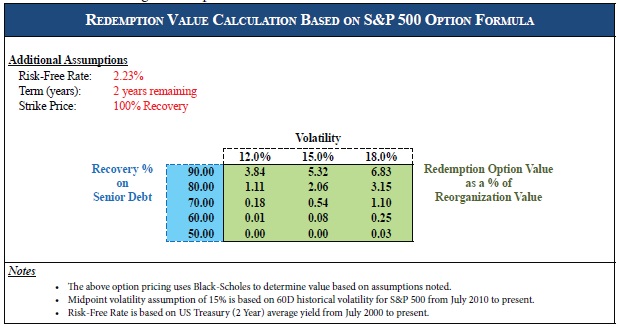
For our discussion, we’ll just have to accept the Black-Scholes part of the calculation as delivered. However, the Commission does provide the following graphic to illustrate the impact of the senior debt’s expected recovery and the assumed volatility on the ROV (as a % of reorganization value):

Chart

For example, at a 50% recovery, and almost regardless of volatility, the ROV as a percentage of reorganization value is basically 0%. However, at a 90% recovery, the ROV ranges from 3.84% to 6.83% for the given volatility assumptions. Under the ROV recommendation, those percentages would be distributed to the immediately junior class as cash, debt, stock, or the like (not as an actual option).

[Black-Scholes is not the only contemplated methodology. In fact, it could be inappropriate or another model (e.g., the “Binomial Options Pricing Model,” a “Monte Carlo” options model, etc.) could be more appropriate.]

Generally, the closer the senior class is to being fully-paid, the more likely it is that there will be an ROV entitlement (and vice versa). ROV for a 50% recovery (or less) would be unusual. Mathematically, relatively shorter cases in relatively volatile markets should produce the most ROV.  And that makes sense given that concerns about those sorts of cases drove the ROV recommendation in the first place.

[We won’t dwell on the slight differences, but the ROV calculation would be made for Section 363 sales too.]

That’s about as detailed as we can get without engaging an expert.

Therefore, we’ll conclude by identifying some of the concerns and criticisms that we gleaned from other articles:

  • The ROV concept (of “relative priority”?) is a significant departure from the absolute priority rule;
  • ROV imposes an inappropriate “tax” or “surcharge” on senior secured creditors;
  • Given the attendant complexity, cases could actually take longer and become more expensive;
  • ROV could have a significant impact on “broader credit markets”;
  • There is no definitive ROV methodology, such that judicial valuation will become even murkier;
  • The procedural elements are unclear regarding objections, etc.;
  • Empirical data justifying ROV is not available (or, at least, was not presented).

The following articles address some of the above criticisms and concerns more extensively:

Redemption Option Value: Broad Implications for Secured Lenders (by Chapman and Cutler, LLP)

(This article is quite critical, but it’s also thoughtful; the Report needs to be challenged and questioned.)

Redemption Option Value: Mandatory Distributions to Out-of-the-Money Stakeholders (by Schulte Roth & Zabel)

(This article addresses concerns, but it’s also useful as an easy-to-follow Q&A.)

Additionally, Prof. Harner addressed ROV (and addressed some of the criticisms) here:

Chapter 11 Reform: Refining the Tools Available to Rehabilitate Distressed Businesses

That should cover Redemption Option Value for the moment. However, we know some super-smart valuation folks who we’re going to try and tackle for their input on ROV–particularly as it relates to the ROV calculation.

In our next post, we’ll continue with Part C.2 (“New Value Corollary”). Stay tuned.

This is the next post in Plan Proponent’s series on the confirmation-related recommendations in the ABI Commission Report (and, in particular, its Exiting the Case piece). Continuing with Part C.1 (“Creditor’s Rights to Reorganization Value and Redemption Option Value”) from our last post, this post will introduce “Redemption Option Value.”

The issue driving the Commission’s ultimate recommendations regarding “redemption option value” is the issue of how best to balance the rights of secured creditors, the rights of other stakeholders, and the debtor’s reorganization needs. Part C.1 is footnote-heavy, with citations to multiple written statements from those who weighed-in on this topic at various ABI Commission Field Hearings. In other words, it’s not an issue that the Commission took lightly.

At a high level, the Commission distinguishes between its recommendations regarding valuation for adequate protection purposes (foreclosure value) (see Section IV.B.1) and valuation for distribution purposes (reorganization value). Of course, that distinction is consistent with Section 506(a), discussed in our prior post

By “reorganization value,” the Commission means the “total enterprise value of the firm, including value generated through the chapter 11 case.”  Subject to (i) Sections 506(c) and 552(b) (which we will address when we cover Sections VI.C.3 and VI.C.4) and (ii) the Commission’s redemption option value recommendations, the Commission believes that senior creditors should receive the “reorganization value of its collateral” via a plan or a 363 sale.

Of course, that entitlement collides with various issues, as the Commission points out:

  • The perception that Chapter 11 cases are being run for the benefit of senior secured creditors;
  • The challenge of restructuring a debtor with little equity in its property;
  • How timing issues impact value allocation among constituencies;
  • How debtors who are overwhelmed by secured debt can be driven to quick 363 sales; and
  • The administrative insolvency that often goes hand-in-hand with the above issues.

The Commission also observes that a debtor’s “fulcrum security” now tends to be “higher in the debtor’s capital structure than in the past.”  The term “fulcrum security” refers to the priority level of the class of debt at which enterprise value is exhausted. Whereas, enterprise value tended in the past to become exhausted at the unsecured debt level, it now tends to be exhausted earlier in the process at the senior creditor or subordinated senior creditor level. Although the Commission explored the possible reasons for that trend, it chose to focus, instead, on how to improve value allocation in Chapter 11 cases.   

Starting with the premise that the valuation cutoff date (i.e., plan effective date or 363 order date) should not, in a hard and fast fashion, leave junior creditors out of the money, the Commission recommends the following “overarching principle”:

“[T]he general priority scheme of chapter 11 should incorporate a mechanism to determine whether distributions to stakeholders should be adjusted due to the possibility of material changes in the value of the firm within a reasonable period of time after the plan effective date or section 363x sale order date, as the case may be, which would enable junior creditors to ‘redeem’ in full the allowed claim of the impaired senior creditors receiving the reorganization value of the company under such plan or sale.”

In other words, under the Commission’s redemption option value (“ROV”) recommendation, a plan could be confirmed as follows:

First, it could be confirmed over the non-acceptance of the immediately junior class if and only if that class receives, at a minimum, the ROV, if any, for that class.

Second, it could be confirmed over the non-acceptance of the senior creditor class, even if that class is not to be paid in full under the absolute priority rule, so long as the absolute priority rule deviation is for the purpose of making the ROV distribution.

If the junior class rejects the plan and challenges the reorganization value that determines the ROV, then the Court should still confirm the plan if (i) the Court makes an evidentiary finding that the debtor did not propose the reorganization value in bad faith and (ii), except for the ROV requirement, the plan satisfies Section 1129(b)’s requirements.

The Commission makes a similar recommendation for the approval of 363 sales (i.e., immediately junior classes get their applicable ROV from the reorganization value if and only if they do not object to the sale).

Essentially, the Commission’s ROV recommendation is a recommendation that distributions should be adjusted due to the possibility of changes in firm value during some reasonable period following confirmation or sale approval. And the “option value attributable to the immediately junior class should be the value of a hypothetical option to purchase the entire firm with an exercise price equal to the redemption price and a duration equal to the redemption period.” Whether it’s an actual option (most likely not) or something else, the ROV should be distributed in some form. 

Frankly, the ROV concept cries out for some concrete examples–we’ll cover those in our next post. Before we get to the examples, though, some qualifications bear emphasis.

First, the Commission determined that, without further study of the cost-benefit, the ROV recommendation should not apply to “small and medium-sized enterprises” (as proposed by the Commission). For the moment, the Commission has proposed separate principles for those enterprises. [We’ll address “SMEs” near the end of this series.]

Second, the ROV recommendation might make sense in simple capital structures, but it likely needs some refining to address more complex capital structures or messy fact patterns (e.g., the senior creditor is not entitled to 100% of the enterprise value; there are multiple senior creditor classes; only a portion of the junior class objects; the junior class is already getting a distribution, but is not being paid in full, etc.).

Third, the ROV recommendation is not intended to alter priorities or change allocations within classes. Rather, the purpose is to give Courts a tool for determining whether there is enough debtor value to justify a distribution to the immediately junior class.

In our next post, we’ll focus on the suggested  nuts and bolts for calculating the ROV, as well as some simple examples that should help illuminate this rather abstract concept.