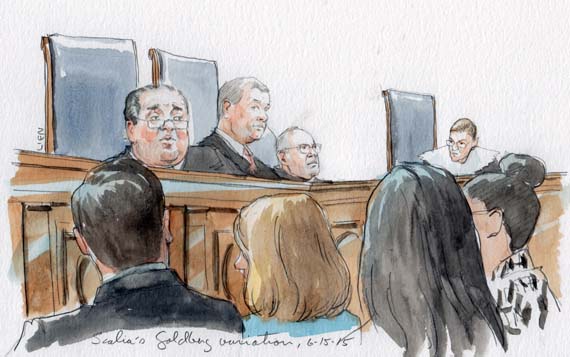
As we discussed in two prior posts, on June 15, 2015, a 6-3 Supreme Court held in the Chapter 11 case of Baker Botts, L.L.P. v. ASARCO, LLC that bankruptcy professionals employed under Section 327(a) of the Bankruptcy Code may not, under Section 330(a)(1) of the Bankruptcy Code, recover as compensation fees incurred in defending their bankruptcy fee applications.

We originally issued this as a 2 part blog post, covering 10 questions each about Baker Botts. Part 1 covered the background and the majority opinion. Part 2 emphasized the dissent, possible errors in the decision, and the potential impacts on bankruptcy practice.

We’ve now combined them below in one, easy-to-download, easy-to-print .pdf.


FirstPage

(Click Image to Download Article)

SupCt2

 (courtesy of Dave’s iPhone on June 18, 2015)

As a recap of Part 1, on June 15, 2015, a 6-3 Supreme Court held in the Chapter 11 case of Baker Botts, L.L.P. v. ASARCO, LLC that bankruptcy professionals employed under Section 327(a) of the Bankruptcy Code may not, under Section 330(a)(1) of the Bankruptcy Code, recover as compensation fees incurred in defending their bankruptcy fee applications.

Baker Botts did not draw nearly as much attention as Obergefell v. Hodges (the same-sex marriage case and subject of the above photo) or King v. Burwell (the Obamacare tax subsidies case). And since we posted Part 1 two weeks ago, the Supreme Court finished the term by issuing additional front-page decisions. Although Baker Botts was caught in the undertow of those decisions, it’s still important, especially for bankruptcy professionals whose compensation depends on § 330(a)(1).

For example, take the mega Lehman Brothers Chapter 11. Our review shows that Weil Gotshal spent over 21,387 hours and over $6.4 million in fees (i.e. an average of 2100+ hours and $641,000+ per fee application) preparing and litigating its fee applications. Whereas Weil’s compensation-related charges were less than 1.5% of the overall bill, it’s not unusual, especially in small consumer Chapter 7 cases (where frivolous fee objections are most common) for a trustee or professional to spend 10%-20% on fee defense. And after Baker Botts, many of those charges aren’t recoverable. Therefore, Baker Botts bears emphasis for all bankruptcy professionals.

Part 1 covered the background and the majority opinion. Part 2 emphasizes the dissent, possible errors in the decision, and the decision’s potential impacts on bankruptcy practice.

[Unless noted otherwise, quotations are from the opinion.]

[Additionally, SCOTUSblog has collected all of the briefs, with a link to Oyez for the oral argument audio.]

11. How did the dissent come down on the issue?

The dissent agrees with the majority that fee-defense is not a “service” under § 330(a)(1). However, unlike the majority, the dissent agrees with the Government that fee-defense work is simply part of the compensation for the “underlying services.” Therefore, the dissent hinges on recognizing a bankruptcy court’s “broad discretion” to determine “reasonable compensation” based on all “relevant factors” (including the possible need to award defense costs to maintain compensation parity between bankruptcy and non-bankruptcy professionals). For the dissent, that need is no different than other factors warranting “increased compensation” (e.g., “exceptionally protracted litigation”).

The thrust of the dissent is best summarized by the dissent’s fee dilution example: What if a professional has fees of $50,000, but spends another $20,000 defending them “against meritless objections”? Arguably, that effective payment of $30,000 is “unreasonable” and warrants additional compensation in the court’s discretion. Indeed, wonders the dissent, how is that form of fee dilution any different than the fee dilution that the Supreme Court rejected in Jean under the Equal Access to Justice Act?

The dissent concludes that interpreting “reasonable compensation” any other way “would undercut a basic objective of the statute.” Therefore, courts should retain broad discretion to award defense costs.

12. Does the dissent believe that § 330(a)(1) displaces the American Rule? 

Yes. The dissent claims that in Alyeska Pipeline, the Supreme Court “recognized that through § 330(a),” Congress “displaced the American Rule.”

However, rather than focusing on how § 330(a) displaces the American Rule, the dissent focuses on JeanSpecifically, it argues argues that if Court found that the Equal Access to Justice Act displaced the American Rule even though it doesn’t explicitly mention fee-defense work, then it’s inconsistent for the majority to find that § 330(a) doesn’t displace the American Rule simply because it doesn’t explicitly mention fee-defense work. Compare the EAJA (“fees,” “prevailing party,” and “civil action”) to § 330(a) (“reasonable compensation for actual, necessary services rendered”). Neither explicitly mentions fee-defense, but the Court treated them differently.

Given that § 330 is arguably the most comprehensive statutory fee regime in all of federal law, we wonder whether the American Rule applies at all. As the amicus fee examiners explained, a “Chapter 11 reorganization proceeding is not inherently or pervasively adversarial.” Thus, the “American Rule is inapposite” to fee-defense costs in bankruptcy. As they suggest, “courts exercise two very different functions” in bankruptcy: adjudication and administration. For the former, the court determines “specific rights through motions, objections, and adversary proceedings.” For the latter, the court ensures that “the progression of the case” follows the Code. Finally, they explain that, unlike in a fee-shifting case, “where the award of fees is part of the litigation itself,” all bankruptcy fees require court review, regardless of whether there is litigation.

In short, associating fee-defense costs with a “winning side” via the American Rule makes no sense in bankruptcy.

13. How does the dissent address § 330(a)(6) regarding fee application preparation?

The dissent doesn’t read § 330(a)(6) as making prep work compensable. Rather, § 330(a)(6) merely clarifies how to calculate reasonable prep work when it’s requested. Further, the dissent rejects the majority’s “mechanic’s invoice” analogy (see Part 1 Q9). Specifically, it criticizes the majority’s argument that, because a fee app is not a condition for payment outside of bankruptcy, a fee app is a service in bankruptcy. If its status as a bankruptcy-specific requirement is what makes it compensable, then shouldn’t the “time that a professional spends at a hearing defending his or her fees” also be compensable? Neither are required outside of bankruptcy. Therefore, both should be compensable under the majority’s view.

In short, the dissent believes that “preparing for or appearing at” a fee hearing is “an integral part of fee-defense work” that should be compensable.

14. Did anyone else come to the defense of bankruptcy professionals?

12 amicus curiae briefs were filed: 10 in favor of Baker Botts; only 1 in favor of ASARCO; and 1 neutral.

15. That’s a lot of support for an ultimately losing position. Did the Court depart from a “majority” view?

Possibly. Some suggest that the Court took the case to resolve a split between the Fifth Circuit (the case on appeal), Eleventh Circuit, and Ninth Circuit. If there was a split, then the Court resolved it in favor of the Fifth and Eleventh Circuits without saying so. In fact, it’s notable that the majority cites only 2 bankruptcy cases that are even remotely close to the issue (Alyeska and Laime) and only 4 bankruptcy cases overall. After the Court’s significant praise of bankruptcy court wisdom in May’s Bullard v. Blue Hills Bank, one would think that the Court would have turned more to the lower courts for direction. Nope.

For point of reference, Robert Keach, Co-Chair of the ABI Commission, summarized the pre-Baker Botts views during the ABI Panel Discussion. The “majority view” was that defense costs aren’t recoverable unless the applicant “substantially prevails” in defending his fees. The “minority” view was that defense costs don’t benefit the bankruptcy estate and, thus, are never recoverable, per se.

See also United States Trustee Large Case Fee Guidelines (recognizing “substantially prevails” exception); amicus brief of Florida Bar (starting at .pdf p. 18) (collecting cases, especially in the 11th Circuit).

 16. Which side got it right? 

The dissent. Although we disagree with the dissent’s conclusion that fee-defense is not a “service,” we agree that the majority erred by adopting a per se prohibition on defense costs rather than leaving them to the court’s discretion under § 330’s comprehensive scheme.

The first possible error is the Court’s insistence on forcing an American Rule discussion on § 330–a “talk about what we know” approach; a “round hole, square peg” sort of error. The Court sidesteps that error (mostly) because, although it talks a lot about the American Rule, the Court ultimately doesn’t base the holding on that rule. Rather, it construed the statute itself (albeit erroneously) by focusing on the intersection of § 327(a) (disinterested persons assisting the trustee) and § 330(a)(1) (necessary services rendered).

The second possible error is the Court’s refusal to use § 330(a)(6) to make defense costs recoverable. At first, it appears that the Court held that defense costs aren’t recoverable because § 330(a)(6) explicitly references fee preparation, but not fee-defense. After all, many of the briefs addressed whether § 330(a)(6) authorizes prep work or merely clarifies how to calculate reasonable prep work when it’s requested. However, the Court dodges those arguments altogether, holding, correctly, that § 330(a)(6) “does not presuppose that courts are free to award compensation based on work that does not qualify as a service to the estate administrator” (i.e., § 330(a)(6) is neither here nor there on compensability).

That gets us to the heart of the Court’s error: It splits § 330 into separate analytical parts rather than recognizing that § 330 works as a whole to calculate reasonable compensation. In the process, the Court adopts a per se prohibition on defense costs that robs courts of the discretion to determine when they benefit the bankruptcy case and/or are necessary for its administration. Thus, the Court ends-up sanctioning the very form of fee dilution that it rejected in Jean.

Specifically, the Court appears to treat § 330 as requiring 2 steps: (1) a threshold § 330(a)(1) determination of whether something is a compensable “service” and (2) a follow-up § 330(a)(3) determination of whether the professional charged the compensable service reasonably. However, we believe that §330(a)(3) and § 330(a)(4) actually inform the threshold “compensable service” determination under § 330(a)(1):

  • § 330(a)(3)(C) emphasizes “whether the services were necessary to the administration of, or beneficial…toward the completion of” the bankruptcy case.
  • § 330(a)(4) emphasizes only paying for services that were (i) “reasonably likely to benefit the debtor’s estate” or “necessary to the administration of the case.”

And by focusing so much on (a)(1) and so little, if at all, on (a)(3) and (a)(4), the Court commits 3 real errors.

Error #1: Court adopts an overly narrow, mutually exclusive view of “benefit.”

The Court adopts an overly narrow, mutually exclusive view of “benefit.” The Court’s view is too narrow because it focuses only on the relationship between the trustee and the professional. For example, the Court recognized that fee preparation is a “service” to the administrator because it “allows the customer to understand–and, if necessary, dispute his expense.” If one looks just at § 330(a)(1), then one might conclude that the administrator is the sole customer. However, (a)(3) and (a)(4) suggest that the “customer” is, in fact, the administrator, the United States Trustee, the constituencies who have claim against the estate, the constituencies that have an obligation to help administer the estate (e.g., committees, fee examiners, etc.), and the court itself.

The Court views “benefit” in a mutually exclusive manner because it doesn’t recognize that a service can benefit the professional and other constituencies without forfeiting disinterestedness. In fact, the compensation process contemplates a certain level of self-interest because it has the estate bearing a professional’s reasonable compensation. For example, preparing a fee application benefits the professional because it’s a condition for payment; it benefits other constituencies because it permits them to satisfy their duty to the estate to “understand” and even “dispute” fee applications. How is fee-defense any different? The Court doesn’t tell us.

Error #2: Court fails to consider if fee-defense is necessary for case administration.

The Court also ignores the alternative basis for compensation: whether a service is “necessary to the administration” or “completion of” the bankruptcy case. After all, the Code requires a detailed and itemized fee application that’s unknown outside of bankruptcy. It requires notice to the United States Trustee and other parties-in-interest. At a minimum, the court must review the application for compliance with § 330. Finally, the trustee can’t satisfy its duty to complete the case until there’s a resolution (not just an assertion) of all claims against the estate, including § 503(b)(2) administrative claims for compensation. And with limited exceptions, such resolution is impossible without a hearing. As Baker Botts argued, “fee-defense litigation is necessary to a case’s completion because it is an indivisible part of a complex fee-assessment process that the Code specifically mandates.”

If “compensability” is the sole province of § 330(a)(1), then it makes no sense for § 330(a)(1) to require that services be “necessary” (and for the Court to read “benefit” into the term “services”) and for (a)(3) and (a)(4) to also emphasize benefit and necessity. In other words, if (a)(1), (a)(3), and (a)(4) don’t work together as a whole, then (a)(3) and (a)(4) are superfluous. 

Error #3: Court flip-flops on fee parity and fee dilution.

Eventually, Jean comes back to haunt the Court. It’s not the language that the majority quotes from Jean (i.e., “We find no textual or logical argument for treating so differently a party’s preparation of a fee application and its ensuing efforts to support that same application.”). After all, there was no doubt in Jean that the EAJA extended to core fees and fee-defense. Rather, it’s the language from Jean that the majority doesn’t quote: “Denying attorneys’ fees for time spent in obtaining them would dilute the value of a fees award by forcing attorneys into extensive, uncompensated litigation in order to gain any fees.”

That brings us to the bottom line: Almost all of the parties argued extensively that a per se prohibition on defense work, without regard to whether the defense is meritorious, could dilute compensation and, thus, contravene Congress’ intent that there be compensation parity between bankruptcy and non-bankruptcy professionals. The parties even screamed that argument from the roof-tops in at least 16 separate briefs. Nevertheless, the Court wasn’t buying it. Relying on its flawed invoice analogy and unsupported assertions about what motivates attorneys, the Court simply dismissed the dilution argument as a “flawed and irrelevant policy argument.” Unfortunately, that’s that.

17. After Baker Botts, which fees and costs are reimbursable and not reimbursable?

The way we read Baker Botts, the “reimbursable v. non-reimbursable” debate is resolved this way:

Employment Applications/Compensation Procedure Motions

There’s nothing in Baker Botts suggesting that fees related to prosecuting § 327 employment applications aren’t reimbursable. A professional benefits from employment matters, but it’s difficult to argue that employment matters aren’t “actual, necessary services.” At bottom, employment applications are the first services rendered to a trustee. That rationale also applies to compensation procedure motions under § 331, as such motions establish a review process that benefits all constituencies and promotes administration.

However, that’s not to say that someone will not try to use Baker Botts to challenge typical “first day” employment or compensation procedure matters.

Fee Statements and Fee Applications

For purposes of Baker Botts, interim fee statements that are served under a procedures order should be treated like interim and final fee applications. Therefore, Baker Botts likely impacts statements and applications as follows: (i) under § 330(a)(6), the cost of preparing, serving, and filing them (as applicable) are recoverable; but (ii) the cost of correcting them and of reviewing and responding to information requests or objections are not recoverable because such costs are in the prohibited “defending” category.

Non-preparation fees and expenses likely amount to “defending” the applicant’s fees and, thus, are not recoverable. They include fee-related corrections, explanations, negotiations, research, and responses occurring after a fee application is served.

Hearings on Compensation Requests

We can argue about whether “after notice and a hearing” requires a hearing when no objection is filed, but our judges, at least, tend to require a hearing unless, under Rule 2002(a)(6), the requested compensation doesn’t exceed $1,000. Under Rule 9014, those hearings fall into 2 categories: (i) uncontested hearings without objections and (ii) contested hearings with objections. Under Baker Botts, preparing for, traveling to, or participating in any contested (“adversarial”) fee hearing is not recoverable.

However, do uncontested hearings fall outside of Baker Botts’ prohibitions? Can the court award compensation for defense costs related to a courtordered fee hearing as long as the applicant merely presents his application, summarizes his fees, and the answers questions to establish a record? We hope so, but probably not.

Baker Botts is not clear. On the one hand, the dissent asserted that the “majority does not believe that preparing for or appearing at [an uncontested hearing]–an integral part of fee-defense work–is compensable.” On the other hand, Robert Keach pointed out that “[u]nder the majority opinion, apparently you can now attend the hearing, but if you do any defending while you’re there, you can’t be paid for that time.” Ultimately, the majority speaks for itself: A court can’t award fees “for work performed in defending a fee application in court.” Therefore, we don’t see a definitive basis for treating uncontested hearings differently (but see Question 18 re: limiting Baker Botts).

Arguing about Baker Botts

Under the Court’s “benefit theory,” applicants will likely bear the expense of obtaining answers to any questions that Baker Botts leaves unanswered.

18. That’s an awfully strict reading of Baker Botts. Can we work around it?

Limiting Baker Botts to its Facts

We might be able to limit Baker Botts to adversarial litigation between the applicant and the debtor (based on the following language that we’ve emphasized):

  • The court can’t “shift the costs of adversarial litigation from one side to the other” (i.e., from “attorneys” to the “administrator“).
  • “Time spent litigating a fee application against the administrator” isn’t “labor performed” for or “disinterested service to” the administrator.
  • The term “services” doesn’t “encompass adversarial fee defense litigation.”
  • Even in the mechanic’s invoice analogy, the Court speaks only of a “battle over a bill.

In other words, the Court emphasizes (1) adversarial litigation (2) between two sides (3) where one side (the applicant) is seeking to have the other side (the applicant’s client) pay its defense fees. That only occurs when the debtor or trustee objects because the shifting of fees, if any, can only be to the debtor or the trustee. Compare that to a dispute between an applicant and a creditor: The applicant is not seeking to transfer the fees to the creditor–the estate bears them or it doesn’t.

Therefore, we might limit Baker Botts in 2 ways, such that the prohibition on defense costs only applies:

  1. When the applicant’s client (i.e., the debtor) objects; or
  2. When an objection leads to litigation (regardless of who objects).

In the former, a pretty aggressive limitation, the “substantially prevails” standard would still apply to non-debtor objections.

In the latter, a less aggressive limitation, uncontested fee hearings would be compensable.

Implementing Contractual Workarounds

Two problematic reactions to Baker Botts might be “I’ll just increase my hourly rate” or “I’ll just get the debtor to agree to pay fee-defense costs.”

Increasing Rates. Although the Supreme Court didn’t mention it, the Fifth Circuit made the rather incredible suggestion that bankruptcy professionals can address fee dilution by “anticipat[ing]” it “in their hourly rates.” As the amicus judges explain, this “rate-padding scheme will make the fee award process less transparent.” Worse, the suggestion should fail the reasonableness test out of the gate.

Finally, how is it fair or loyal to burden all clients with padded fees that are otherwise not compensable just because a few clients might embroil the professional in fee litigation? The New York Bar stated it best: “It would be an odd system indeed that allowed professionals to be compensated for defending fee applications indirectly through their hourly rates instead of directly through compensation for reasonable actual defense fees.”

Modifying Engagement Letters. The Court held that the American Rule applies “unless a statute or contract provides otherwise” (emphasis added). Therefore, can having debtors agree to pay for defense costs displace the American Rule as a matter of contract? Probably not. First, does an attorney have an ethical duty on the front-end to disclose Baker Botts? How would that conversation go? “The Supreme Court just held that you aren’t required to pay for defense costs, but I’d like you to pay them anyway.” Second, even if the debtor agrees to pay for defense costs, wouldn’t the attorney simply be setting himself up for a § 327 employment objection when he discloses the terms to the court?

Freedom of contract is important, but we aren’t sure how it can trump the Code on compensation limitations and reasonableness.

Applying for Employment under Section 328

Some, including those on the ABI Panel Discussion, have wondered whether § 328(a) provides a workaround. Under § 328(a), a court may approve in advance “reasonable terms and conditions of employment” for a professional. A § 328(a) compensation arrangement cannot be altered after the conclusion of the employment unless it proves “improvident in light of developments not capable of being anticipated.” Typically, § 328 issues arise with investment bankers and the like, and the reasonableness of their retainers.

We also don’t see how § 328 helps. After all, the court still has a duty to determine whether the terms are “reasonable.” We’d think that Baker Botts will bear on that determination. Such an arrangement might also be an improper attempt to contract around § 328(a)’s disinterestedness requirement.

Of course, if (and it’s a big “if”), the court approves payment of fee-defense costs on the front-end, then § 328 likely is a solution.

Seeking Sanctions under Rule 11

The majority remarked that if the “United States harbors any concern about the possibility of frivolous objections to fee applications,” then Rule 9011 “authorizes the court to impose sanctions for bad-faith litigation conduct.” However, as the amicus judges explained, the “standard for imposing sanctions is too high for bankruptcy judges to prevent dilution with that rarely used cudgel” (citing a Delaware bankruptcy case holding that the “stringent” Rule 9011 standard demands “exceptional circumstances” where a claim is “patently unmeritorious or frivolous”). Even ASARCO’s objections weren’t patently frivolous. Finally, even a successful Rule 9011 movant will be lucky to break-even on the cost and burden of litigating Rule 9011.

19. Does Baker Botts impact the award of “fee enhancements”?

No. The issue of enhancements was a big issue below, but the parties didn’t take it up. Some might say that the lower court decisions advance the cause for fee enhancements. Others might say that a fee enhancement from “probably the most successful Chapter 11 of any magnitude in the history of the Code” is hardly helpful precedent in (surely) more humble cases.

20. What are others saying about Baker Botts? Have courts gotten involved yet?

What Others are Saying

Law360 collected various reactions to Baker Botts here, including one from Dechert’s Eric Brunstad Jr. (a Supreme Court bankruptcy star in his own right):

“Bankruptcy is a highly specialized context, and reliance on general fee-shifting principles is at odds with the purpose, policy, and reality behind the supervision and award of fees in Chapter 11 cases. Unfortunately, this decision will create problems in the administration of Chapter 11 matters.”

Similarly, Prof. Stephen Lubben, one of the amici and a frequent Credit Slips contributor, observed that:

“The majority seems to be totally out of touch with the reality of bankruptcy practice, and its opinion seems to be an open invitation for bomb throwers who stop just short of Rule 11.”

You can find additional commentary by listening to the excellent ABI Panel Discussion.

What the Courts are Saying

So far, 6 courts have cited Baker Botts, but not on the fee-defense issue. As an aside, we couldn’t help but notice that one of our S.D.G.A. judges cited it on the general issue of statutory interpretation. We’ll keep our eyes on other cases.

CONCLUSION

Our knee-jerk reaction to Baker Botts was that it represents another example of the Supreme Court’s disdain for bankruptcy practice. Perhaps we’ve been recovering fee-defense costs for so long that we can’t imagine bankruptcy practice any other way. Nevertheless, Baker Botts is now controlling law. The most that we can probably hope for is that lower courts will limit Baker Botts to fee litigation rather than fee presentation, such that the cost of court-ordered, uncontested fee hearings is still compensable.

Supreme Court

 (courtesy of Dave’s iPhone on June 18, 2015)

Two Thursdays ago, we visited my wife’s family in Potomac, Maryland. In addition to seeing the usual sites, we did a Supreme Court “drive-by” and snapped the above photo, a very timely now outdated, but still very political picture.

Indeed, Friday morning, the Supreme Court issued its 5-4 decision in Obergefell v. Hodges ruling that same sex-marriage is a Constitutional right. The day before, it issued its 6-3 decision in King v. Burwell upholding tax subsidies under the Affordable Care Act (a/k/a “Obamacare”). And, as a I type, folks are waiting impatiently for the Supreme Court (i.e., “Waiting for Lyle“) to issue at 10 a.m. the remaining decisions from this term on congressional redistricting, power plant emissions, and execution methods. Meanwhile, the ink is now two weeks old on the Court’s Baker Botts, L.L.P. v. ASARCO, LLC decision, a much less-awaited decision that likely didn’t attract protestors to the Courthouse steps.

Nevertheless, Baker Botts is an important case for bankruptcy professionals, especially those who aren’t strangers to fee application litigation. In a nutshell, a 6-3 Supreme Court, with Justice Thomas delivering the opinion, held that bankruptcy professionals may not, under Section 330(a)(1) of the Bankruptcy Code, recover their fees and costs in defending their bankruptcy fee applications.

In this post, we’ll experiment with a “20 Questions” format to see if we can get to the heart of the matter: How will Baker Botts impact day-to-day bankruptcy professionals, including those whose compensation depends the Code’s “fee app” procedure? In Part 1, we’ll cover the basics, including background and the majority opinion. In Part 2, we’ll cover the dissent, humbly challenge the decision, and, more importantly, explore the potential impacts, legal and practical.

[Unless noted otherwise, quotations are from the opinion.]

1. How did this matter find its way to the Supreme Court?

In 2005, ASARCO, one of the leading copper producers in the U.S., filed a free-fall Chapter 11 in the Southern District of Texas. ASARCO had everything wrong with it: cash flow issues; potentially massive environmental liabilities; corporate governance and tax problems; a striking workforce; and a litigious parent company. As the bankruptcy court pointed out in its initial fee award order (see p. 65a), the DOJ described the ASARCO case as “the largest environmental bankruptcy in U.S. history.” ASARCO’s CEO and board resigned and its replacement director conflicted-out. Therefore, the Bankruptcy Court approved the appointment of an independent board.

In pertinent part, ASARCO, acting through its new board and with court authorization under § 327(a) of the Code, retained Baker Botts as well as Jordan, Hyden, Womble, Culbreth & Holzer as its bankruptcy counsel. Among other things, the lawyers prosecuted a fraudulent transfer claim against two of ASARCO’s parent entities, ASARCO, Inc. and Americas Mining Corp. (“AMC”). The claim challenged ASARCO’s transfer to AMC of ASARCO’s controlling interest in Southern Copper Corp. ASARCO obtained a judgment against the parent worth between $7 and $10 billion. In turn, the judgment fueled a 100%, $3.56 billion payout to creditors (compared to the pennies on the dollar that most had expected at the beginning of the case). ASARCO emerged from bankruptcy 4 years later in 2009 with “$1.4 billion in cash, little debt, and resolution of its environmental liabilities.”

After confirmation, the 2 law firms filed their final fee applications under § 330(a)(1). ASARCO, by then reorganized and back under the control of its parent, objected to the fee applications. Following extensive discovery and a 6-day trial, the Bankruptcy Court overruled the objections and awarded $120 million in compensation, $4.1 million as an “enhancement for exceptional performance,” and $5 million in fees for defending the applications.

On appeal, the District Court affirmed the Bankruptcy Court, but the Fifth Circuit reversed. The Fifth Circuit held that (i) the American Rule (discussed below) controls absent explicit statutory authority providing reimbursement of defense fees and (ii) defense fees fall outside of § 330(a)(1)’s requirement that services are only compensable “if they are likely to benefit a debtor’s estate or are necessary to case administration” because the professional, not the estate, is the “primary beneficiary of a professional fee application.” For a more detailed summary of the lower court decisions, see Gregory Werkheiser’s excellent Jan. 2015 ABI Journal article.

The Supreme Court then granted certiorari and heard oral argument on February 25, 2015 (transcript and audio). Aaron Streett of Baker Botts argued for Baker Botts. Brian Fletcher, Asst. to the Solicitor General, argued for the United States as amicus curiaeJeffrey Oldham of Bracewell & Giuliani argued for ASARCO. [Interestingly, after ASARCO’s initial Aug. 2014 brief in opposition to the petition, ASARCO added Supreme Court star Paul Clement of Bancroft (along with Jeffrey Harris) to ASARCO’s Jan. 2015 brief, but neither Paul nor Jeffrey presented. Having their names on the signature block probably didn’t hurt, though.]

2. For the most part, those are the official Supreme Court facts. What was really going on?

Given that the majority focuses exclusively on the text of the Bankruptcy Code while ignoring “flawed and irrelevant” policy arguments, the Court’s rather vanilla recitation of a hotly-contested, 7 year fee dispute is forgivable. After all, the Code either permits compensation for defending fees or it doesn’t. Nevertheless, depending on who you believe, there was quite a bit more going on in Baker Botts–it wasn’t just any old attorneys’ fee dispute.

In fact, the results obtained in ASARCO were so breathtaking and the core fee objections so unsuccessful, that it’s astonishing that this case became the test case for fee-defense costs under § 330(a)(1).

Largest Judgment and Most Successful Chapter 11 Ever?

As Baker Botts pointed out in its petition, the lower courts had acknowledged that the judgment that Baker Botts obtained for ASARCO was the largest judgment “in Chapter 11 history and possibly the largest unreversed actual-damages award in American history” (compared to the $7.53 billion actual-damages Pennzoil v. Texaco judgment, another Baker Botts award). Further, it pointed out in its petition that (i) the Bankruptcy Court noted that the ASARCO case was  “probably the most successful Chapter 11 of any magnitude in the history of the Code” (our emphasis); (ii) the District Court called the judgment “a once in a lifetime result” (ours again); and (iii) the Fifth Circuit agreed that the result was due to ASARCO’s lawyers’ “exemplary” performance and “creativity, tenacity and talent.” Indeed, the Fifth Circuit noted that “[w]e do not disagree with the lower courts’ effusive evaluations of the results obtained.”

Nevertheless, ASARCO objected to the fees charged by Baker Botts.

Baker Botts describes the fee fight one way; ASARCO describes it another way.

According to Baker Botts:

Baker Botts pointed out that although it received 100% payment from ASARCO on 13 interim fee statements over 52 months without objection, Reorganized ASARCO still “launched a massive assault” on the final application and “attacked everything.” It “stonewalled every effort at efficiently resolving its objections,” “refused” to be particular about which entries were objectionable and, thus, “forc[ed] Baker Botts to self-audit thousands of pages of invoices, culminating in a 1160-page supplement.” Further, “less than a month before the fee trial,” it “served Baker Botts a 104-page report accompanied by a 16-foot-tall stack of schedules containing thousands of pages of individual billing entries alleged to be non-compliant.”

According to Baker Botts, the “U.S. Trustee joined none of these objections, nor indeed any objections to Baker Botts’ core fees” of about $113 million. ASARCO “demanded immense discovery, forcing production of every single document that hundreds of professionals created or received during the 52-month bankruptcy.” Baker Botts claimed that 9 of its lawyers and their staff spent 2,440 hours reviewing hundreds of boxes of offsite documents just to protect privilege. It claimed that it ultimately “produced 2,350 boxes of hard-copy documents (nearly six million pages) and 189 GB of electronic data (approximately 325,000 documents).” In response, claims Baker Botts, ASARCO “sent just two lawyers to review the massive results of discovery” and only “copied 1% of the material” during its five day review.

To hear Baker Botts tell it, ASARCO filed a spiteful, meritless fee objection to get back at Baker Botts for having sued ASARCO’s parent.

According to ASARCO:

ASARCO highlighted a “substantial rise in copper prices”–something Baker Botts “cannot claim responsibility for”–as a “key factor” in ASARCO’s 100% payout to creditors. ASARCO also reminded the Court that Baker Botts initially sought more than it was awarded: $120 million in core fees, over $24 million in fee enhancements, and over $8 million in fee defense costs. It generally summarized its objection categories for the Court: excessive, vague, block-billed, lumped, and/or non-compensable clerical or administrative time and expense entries. It noted that the parties had resolved some expense-related objections by agreement. ASARCO explained that it objected to the enhancements because Baker Botts “had been adequately compensated at their full hourly rates that they had set—and increased throughout the bankruptcy—and that these lodestar fees were paid without delay during the bankruptcy.”

It argued that “over $8 million in fees for the five-month litigation over fees [including 191 Baker Botts timekeepers] was excessive.” It disagreed with Baker Botts’ claim that “every single objection was overruled” because, in fact, Baker Botts had agreed to a $112,927 and a $19,463.52 reduction in fees and expenses [for a total reduction of only 0.09%?!], respectively. It also claimed that the Bankruptcy Court had reduced the requested fee enhancement to around $20 million. ASARCO explained that the bankruptcy court found that the defense costs were “higher than were reasonable and necessary” and, thus, reduced them from $8 million to $5 million. Finally, ASARCO noted that, although the bankruptcy court overruled ASARCO’s objections to the core fees (“after agreed-upon reductions”), the court did not find that the objections were “frivolous or made in bad faith”–objections that cost ASARCO “almost $2 million in fees” to litigate.

To hear ASARCO tell it, ASARCO’s objection was merely a garden variety and good faith inquiry into Baker Botts’ significant fees.

Although ASARCO defends the appropriateness of its objection a little more vigorously in its second brief, it still focuses more on Baker Botts’ excessive defense fees than it does on the merits of ASARCO’s objection, suggesting that Baker Botts might have a point about ASARCO’s possible ulterior motive in filing the objection and litigating it for 7 years. But then again, we represent debtors, so of course we read it that way.

3. How did the Justices come down? 

The Goldberg Variation6-3

Majority: Justice Thomas delivered the opinion, with Justices Roberts, Scalia, Kennedy, and Alito joining, and Sotomayor joining all but part III B 2.

Dissent: Justice Breyer delivered the dissent, with Justices Ginsberg and Kagan joining.

As an aside, compliments of SCOTUSBlog, after Justice Thomas delivered the opinion, Justice Scalia announced Kerry v. Din (and in process, inadvertently referred to Justice Ginsberg as Justice “Goldberg.” Hilarity ensued.


(Image by Art Lien via SCOTUSBlog)

4. In one sentence, how did the majority hold?

Professionals employed under § 327(a) of the Bankruptcy Code are not entitled under § 330(a)(1) to recover fee-defense costs incurred in “defending” their own fee applications.

5. In two sentences, what was the rationale?

The American Rule (i.e., the rule that each litigant pays his own attorney’s fees) is deeply rooted in the common law and, thus, is presumed to apply absent express statutory or contractual language. Given that § 327(a) and § 330(a) of the Bankruptcy Code do not expressly shift the burden of fee-defense litigation to the bankruptcy trustee, and only provide for reasonable compensation for actual, necessary services rendered to a bankruptcy trustee in a loyal and disinterested manner, it follows that Congress did not intend to depart from the American Rule with respect to fees incurred by bankruptcy professionals in defending their fees, especially given that such fees neither constitute “services” to nor benefit the estate.

6. Why is the Supreme Court so focused on the American Rule?

Without any analysis, the Court presumes that § 330(a)(1) is a statute that involves an “award of attorney’s fees.” Although we don’t agree with the Court’s application of the American Rule to § 330(a)(1) (more on that later), the Court’s assumption is not without support at a basic, textual level, as § 330(a)(1) explicitly provides that the court, and we quote the statute, “may award to a trustee . . .or a [§ 327 or  § 1103] professional . . . reasonable compensation for actual, necessary services rendered” (emphasis added). Thus, the Court’s “basic point of reference” is the “American Rule” where each “litigant pays his own attorney’s fees, win or lose, unless a statute or contract provides otherwise” (internal quotation marks omitted).

Hence the approach: When a statute involves an award of attorneys’ fees, the Court will not, “absent explicit statutory [contractual?] authority,” “deviate” from the American Rule.

7. Why did the Court refuse to deviate from the American Rule with respect to § 330(a)(1)?

The Court concluded that “Congress did not expressly depart from the American Rule” to permit fee-defense awards. In searching for that express departure, the Court starts with § 327(a) which provides for the employment of “disinterested” professionals “to represent or assist the trustee in carrying out the trustee’s duties” under the Code. In other words, “professionals are hired to serve the administrator of the estate for the benefit of the estate.”

The Court then turns to § 330(a)(1), concluding that “reasonable compensation for actual, necessary services rendered” is limited to “work done to assist the administrator of the estate.” It explains that, unlike the language in other fee-shifting statutes (more on those later, too), the language in § 330(a)(1) “neither specifically nor explicitly authorizes courts to shift the costs of adversarial litigation from one side to the other” (our emphasis for later). Rather, it only permits compensation awards for “work done in service of the estate administrator” (emphasis in original); “for ‘actual, necessary services rendered‘” (emphasis in original).

Adopting the Government’s analysis almost verbatim and focusing on the dictionary definition of “services” (“labor performed for another”), the Court holds that time “litigating a fee application against the administrator of a bankruptcy estate cannot be fairly described” as “labor performed” much less “disinterested service” to that administrator (i.e., “client”). [As the Government states it, “it is work that the professional does on its own behalf”.]

In short, if Congress had wanted to shift fee-defense costs, then it “easily could have done so,” but it didn’t.

The Court asserts that “other provisions of the Bankruptcy Code expressly” shift litigation costs from “one adversarial party to the other,” but it only refers to one: § 110(i) (requiring petition preparers to pay debtors their “reasonable attorneys’ fees and costs” for moving successfully for damages for preparer violations).

8. Does the majority agree that fee-defense is a part of the underlying services, though?

No. That was the Government’s argument (and the dissent’s take): Even though fee-defense is not, itself, “an independently compensable service,” compensation for fee-defense is “part of the compensation for the underlying services in [a] bankruptcy proceeding” (quoting the Government’s brief) (emphasis in original). The majority rejects that argument (and, thus, the dissent, which we’ll cover in Part 2) because “reasonable compensation” is only available “for actual, necessary services rendered.” In other words, a fee or cost is only compensable if it arises from actual and necessary services. Because fee-defense is not a service, according to the Court, it’s not compensable and, thus, its reasonableness is irrelevant.

The Court would have us first determine whether a fee or cost is compensable and if, and only if, it’s compensable, then determine its reasonableness. In fact, it appears that the Court views the reasonableness factors in § 330(a)(3) as irrelevant to the question of whether something is compensable, as those factors presume that the applicable fee or cost satisfies the threshold “Is it compensable?” test. We don’t view it that way. See Question 16 in Part 2

9. How does the Court address § 330(a)(6) regarding fee app preparation?

The Government relied on § 330(a)(6) which provides that “[a]ny compensation awarded for the preparation of a fee application shall be based on the level and skill reasonably required to prepare the application” (emphasis added). However, the Court rejects the Government’s argument that “because time spent preparing a fee application is compensable, time spent defending it must be too.” The Court explains that, whereas fee application preparation is a service rendered to the estate administrator, “defense of that application is not.” The Court relies on a strained analogy to a “car mechanic’s preparation of an itemized bill”: Preparation of the bill is a service to the customer because it helps the customer understand and even dispute its bill; however, a “subsequent court battle over the bill” is not a “part of the ‘services rendered’ to the customer.”

Further, the Court, without naming them as such, quotes against the Government the United States Trustee Large Case Fee Guidelines. In the Guidelines, the USTP opined that fee app preparation is compensable because it’s “not required for lawyers practicing in areas other than bankruptcy as a condition to getting paid” but fee app defense is not compensable because it’s “for the benefit of the professional and not the estate.”

Finally, the Court distinguishes its “remark” in Commissioner, Ins. v. Jean that “[w]e find no textual or logical argument for treating so differently a party’s preparation of a fee application and its ensuing efforts to support that same application.” The Court explains that “everyone agreed” that the Equal Access to Justice Act (EAJA) at issue in Jean “authorized court-awarded fees for fee-defense litigation” because “fees and other expenses . . . incurred . . . in any civil action” didn’t support a distinction between the legal work and fees defending it. And based on the Court’s narrow reading of “services rendered,” the language in § 330(a)(1) “reaches only the fee-application work.”

At bottom, the Court didn’t view “reasonable compensation” (an “open-ended phrase”) as a “specific and explicit” provision signaling a departure from the American Rule.

[Admittedly, we weren’t aware that the Fee Guidelines already come down so hard on post-preparation fees and costs (including explaining, defending, or litigating the application). However, Baker Botts takes it a step further by eliminating from the Guidelines any notion that compensation might be available if an applicant “substantially prevails” at trial in defending its application. Some suggest that, before Baker Botts, the “substantially prevails” approach in the Guidelines was the “majority” approach. Not anymore.]

10. How does the Court address the “parity” issue regarding non-bankruptcy professionals? 

“Ultimately,” the Court holds, the “Government’s theory rests on a flawed and irrelevant policy argument”: that awarding defense fees is a “judicial exception” that is “necessary to the proper functioning of the Bankruptcy Code.” Specifically, argues the Government, uncompensated fee-defense costs “will be particularly costly” because multiples parties can object in bankruptcy versus the usual lawyer versus client dispute outside of bankruptcy.

The Court rejects the Government’s argument for two reasons. First, the Court refused to substitute “unsupported” and “policy-oriented” predictions for the “statutory text,” especially given that the Government had argued the opposite view below (i.e., “requiring a professional to bear the normal litigation costs of litigating a contested request for payment . . . dilutes a bankruptcy fee award no more than any litigation over professional fees”) (we add emphasis for Part 2). Second, the Court figured that the threat of sanctions under Rule 9011 provides a sufficient deterrent or remedy for “frivolous” fee objections (more on that later, too).

In short, text trumps policy:

  • “Our unwillingness to soften the import of Congress’ chosen words even if we believe the words lead to a harsh outcome is longstanding” (quoting Lamie v. United States Trustee, 540 U. S. 526, 538 (2004)) (internal quotation marks omitted). “[T]hat is no less true in bankruptcy than it is elsewhere.”
  • “Our job is to follow the text even if doing so will supposedly ‘undercut a basic objective of the statute.’”

[But for the Court’s Thursday ruling in King v. Burwell, those quotes (joined by Chief Justice Roberts) might not be surprising. However, in upholding the health insurance tax subsidies (“saving Obamacare!” as some accuse or celebrate), Chief Justice Roberts explained that “in every case we must respect the role of the Legislature, and take care not to undo what it has done. A fair reading of legislation demands a fair understanding of the legislative plan. Congress passed the Affordable Care Act to improve health insurance markets, not to destroy them. If at all possible, we must interpret the Act in a way that is consistent with the former, and avoids the latter.”]

In Part 2, we will dive into the dissent, challenge aspects of the decision, and explore the potential impact of Baker Botts, especially on Chapter 11 debtors’ attorneys. Stay tuned.

In the meantime, we encourage you to subscribe to Plan Proponent to receive important updates as they’re posted (including Part 2).


This is the next post in Plan Proponent’s series on the plan confirmation-related recommendations in the ABI Commission Report (and, in particular, its Exiting the Case piece).We’ve switched over to Section F of the Report regarding “Plan Voting and Confirmation Issues.” Subsection 4, the focus of this post, addresses Plan Settlements and Compromises.

Background

Settlements and compromises in Chapter 11 come in 2 forms: (1) standalone settlements proposed under Rule 9019 and (2) settlements contained in a Chapter 11 plan. Although a plan “embodies a series of compromises between the debtor and its creditors to resolve the debtor’s financial distress,” the latter refers to more substantive settlements that do not necessarily relate to the claims allowance process.

Whereas standalone settlements clearly require notice and a hearing under Rule 9019, the extent to which Rule 9019 impacts, or should impact, settlements contained in plans is not as clear. As the Commission points out, courts approach it differently:

  • Some evaluate a plan settlement via the confirmation process under Section 1129, without separate evidence and with an emphasis on the votes.
  • Others require a separate Rule 9019 motion or, at least, separate evidence regarding the settlement at confirmation.

As the Commission also points out, there’s a definite interplay between settlements and plans. On the one hand, a pre-plan settlement might dictate the flow of funds or recoveries or do an end-run around confirmation requirements to such a degree that it’s a “sub rosa” plan (i.e., a plan that avoids the scrutiny that comes with Section 1129). (See also this post where we discussed the Commission’s recommendations on “gifting” provisions and the absolute priority rule. In particular,  In re Iridium Operating, LLC, 478 F.3d 452 (2d Cir. 2007) addressed whether gifting provisions–as potential absolute priority rule workarounds–must be scrutinized via Rule 9019). On the other hand, a settlement in a plan might not be linked to class treatment, such that creditors might be unaware of the settlement or its potential impact on their claims.

Commission Recommendations

The Commission distinguishes between settlements that are integrated into the claims allowance process and those that should be subject to separate approval. Whereas the Commission believes that the former should be covered by the standard voting and confirmation process, it believes that the latter requires special attention by the court. Specifically, the “court should separately approve any consensual resolution of a material dispute affecting property of the estate, including matters in pending or threatened litigation or regulatory review.”

To that end, the Commission recommends that Section 1129(a)be amended to require that the court specifically find that all settlements and compromises included in, or related to, the plan are ‘reasonable and in the best interests of the estate’ as part of the confirmation process” (but without the need for a separate motion or hearing).

See Section V.G (p. 183) of the Report for more about the Commission’s recommendations on the “Standard for Reviewing Settlements and Compromises.”

Our Take

To the extent that plan proponents are including in their plans what would other wise be standalone, material settlement proposals, the recommendation that Section 1129 be amended to address them explicitly and separately is sensible. However, in our experience–which very well might differ from others’ experience–sophisticated creditors with significant claims, especially those that are in dispute, tend to insist on separate, 9019-style agreements and even insist that such agreements be irrevocably binding on the debtor and not be conditioned on subsequent confirmation of a plan. Therefore, we’re a little more concerned about the potential for sub rosa plans, a topic that will surely come-up in later posts.

In our next post, we’ll wrap-up Section F with a discussion of “Discharge of Claims upon Confirmation.”

This is the next post in Plan Proponent’s series on the confirmation-related recommendations in the ABI Commission Report (and, in particular, its Exiting the Case piece).We’ve switched over to Section F of the Report regarding “Plan Voting and Confirmation Issues.” Subsection 3, the focus of this post, addresses “Designation of Voting Rights.”

Background

Under Section 1126(e) of the Bankruptcy Code, on the request of a party-in-interest and after notice and a hearing, the court may “designate any entity whose acceptance or rejection of [a Chapter 11] plan was not in good faith or was not solicited or procured in good faith or in accordance” with the requirements of Chapter 11. In other words, the court may disqualify votes that were not made in good faith. The requesting party has a heavy burden of proof.

Although self-interest, alone, is not enough, courts often find “bad faith” when a claimant: 

  • Attempts to obtain a personal advantage not available to other creditors in its class;
  • Has an “ulterior motive” (e.g., pursuit of collateral or competitive advantage unrelated to its claim);
  • Acts inconsistently with protecting its self-interest as a creditor;
  • Seeks to assume control of the debtor;
  • Attempts to put the debtor out of business;
  • Seeks to destroy the debtor out of “pure malice”; or
  • Seeks a benefit under a third party agreement that depends on a failed reorganization.

Commission Recommendations

The Commission concluded that Section 1126(e) is an effective means of addressing creditor conflicts of interest. However, it struggled in choosing a standard for determining when self-interested creditor conduct warrants a loss of voting rights. 

Ultimately, the Commission recommended that Section 1126(e) be amended to permit courts to consider whether the creditor’s vote was (i) “manifestly adverse” to other general creditors in the creditor’s class or (ii) cast in bad faith. “This hybrid standard would preserve creditor autonomy, but also provide courts with statutory authority to protect the estate and general creditors when a class vote has been infected by a creditor’s conflict of interest.”

Our Take

Vote designation is nice in theory. However, given the still-heavy, very fact-intensive burden of proof, it’s likely not a practical option for debtors except in egregious cases (i.e., cases where the need for vote designation is manifest, with or without an amendment to Section 1126). Claiming “ulterior motives” or “pure malice” is one thing; proving them up so clearly that they defeat the presumption that a creditor is merely protecting its self-interest is quite another. In short, Section 1126(e) is expensive to litigate for debtors and not exactly difficult to wiggle out of for creditors.

Notably, the Commission did not cite the leading case of In re DBSD North America, Inc., 634 F.3d 79 (2d Cir. 2011) (designating the vote of a late-on-the-scene claims buyer who bought an entire class of cla, ims with the intention of blocking any plan that did not provide it a strategic interest in the reorganized debtor and disregarding that class for purposes of Section 1129(a)(8), which section we touched on briefly here).

DBSD provides a good summary of Section 1126(e) (see pages 101-102):

The Code provides no guidance about what constitutes a bad faith vote to accept or reject a plan. Rather, § 1126(e)’s “good faith” test effectively delegates to the courts the task of deciding when a party steps over the boundary….Bankruptcy courts should employ § 1126(e) designation sparingly, as “the exception, not the rule….Merely purchasing claims in bankruptcy “for the purpose of securing the approval or rejection of a plan does not of itself amount to ‘bad faith.’” Nor will selfishness alone defeat a creditor’s good faith; the Code assumes that parties will act in their own self interest and allows them to do so….Section 1126(e) comes into play when voters venture beyond mere self-interested promotion of their claims. “[T]he section was intended to apply to those who were not attempting to protect their own proper interests, but who were, instead, attempting to obtain some benefit to which they were not entitled.” A bankruptcy court may, therefore, designate the vote of a party who votes “in the hope that someone would pay them more than the ratable equivalent of their proportionate part of the bankrupt assets,” or one who votes with an “ulterior motive,” that is, with “an interest other than an interest as a creditor.”

DBSD suggests that extra scrutiny is warranted for those who buy claims during a Chapter 11 case, especially after a plan has been proposed and especially if the party bought the claims above par.

Additionally, the Southern District of New York addressed Section 1126(e) and DBSD rather extensively last July in In re LightSquared Inc., 513 B.R. 56 (Bankr. S.D.N.Y. Jul. 11, 2014). That decision is useful because it tests the limits of DBSD, clarifies that Section 1126(e) is vote- and plan-specific (i.e., intent must be linked to the vote itself), and also warns against “conflating” the bad faith required under Section 1126(e) with the inequitable conduct required under Section 510, which section we covered here). Declining to designate, the court explained as follows:

[V]ote designation should not be ordered where a creditor can articulate a valid business reason for rejecting a plan even if such rejection may also be consistent with such creditor’s non-creditor interests….Here, there is an ample basis to find that, notwithstanding SPSO’s alleged ulterior motives, its non-creditor/competitor interests, and its demonstrably inequitable conduct in acquiring at least a substantial portion of its claim, it cast its vote to block a plan that provided it with abysmal treatment that no similarly-situated creditor would have accepted.

In our next post, we will address the Commission’s recommendations on Plan Settlements and Compromises.

This is the next post in Plan Proponent’s series on the confirmation-related recommendations in the ABI Commission Report (and, in particular, its Exiting the Case piece).We’ve switched over to Section F of the Report regarding “Plan Voting and Confirmation Issues.” Subsection 2, the focus of this post, addresses “Assignment of Voting Rights.”

Background

It’s not uncommon for creditors with claims against a common debtor to enter into pre-petition subordination or intercreditor agreements. Although they usually address payment priority, allocation of collateral, and the like (i.e., state law matters), they might also address bankruptcy matters, including the assignment or waiver of Chapter 11 plan voting. Creditors might also seek voting assignments outside of such agreements.

As a result, courts have had to determine whether pre-petition voting assignments are enforceable. When they’re embodied in subordination agreements, the starting point is 11 U.S.C. 510(a). Section 510(a) provides that a “subordination agreement is enforceable . . . to the same extent that such agreement is enforceable under applicable nonbankruptcy law.” Section 510(a) is pretty straightforward for agreements involving state law matters. However, courts have struggled with subordination agreements that address (federal) bankruptcy rights, including voting.

The Commission summarizes the two competing views:

  1. View 1: Section 1126 provides that the “holder of a claim or interest allowed under section 502 of this title may accept or reject a plan.” Therefore, if a junior creditor holds a particular claim against the debtor, then only the junior creditor can vote the claim (not the senior creditor via assignment ). Additionally, this view questions whether parties can waive federal rights that are only available under federal law.
  2.  View 2: Section 1126 should be read more broadly. Specifically, it does not “prohibit the delegation of rights associated with claims held by a creditor.” Additionally, this view looks to Section 510(c) and Bankruptcy Rules 3018 and 9010 for the idea that enforceability under state law is the only condition for enforcement.  

Additionally, the Commission raises the “empty creditor problem” (i.e., the decoupling of voting and economic rights that results from a waiver or assignment). The Commission explains that such a decoupling can not only change the interests and objectives of the party holding the decoupled claim, but it might also cause creditors in a particular class (i.e., those with economic risk versus those without economic risk) not to be “similarly-situated.” (We discussed the “similarly-situated” requirement in our last post). The Commission points out that the empty creditor problem is mostly an issue with credit default swaps but it can also be an issue with voting assignments.

Commission Recommendations 

Similar to its approach to other issues, the Commission approaches the voting assignment issue by weighing (i) the need to respect private contract rights, on the one hand, and (ii) fostering the goals of Chapter 11, on the other hand.

The Commission recommends respecting private contract rights when it comes to payment priority agreements. However, it recommends prohibiting voting assignments that are separate and apart from the economic claim. The Commission does not believe that prohibiting voting assignments will damage or significantly impact payment priority agreements.

First, the Commission expresses concerns that subordination agreements have expanded well beyond payment ordering among non-debtors. Second, it concludes that “holder of the claim” in Section 1126(a) suggests that some sort of “nexus” between the vote and right to payment is necessary. Finally, the Commission is concerned that voting assignments can give senior creditors the ability to “influence the plan structure or control the vote on the plan” and “affect valuations of the debtor’s assets,the debtor’s postconfirmation operations and capital structure, and the value ultimately available for distributions to other stakeholders.”

The Commission’s rationale extends to partial claim assignments and voting assignments that arise outside of subordination agreements: maintaining the link between the vote and the right to payment should help mitigate the potential for abuse. And any wrinkles arising in the “derivative or swap product” context can–you guessed it–be resolved by the court on a case-by-case. (Actually, it’s a little more nuanced than that–the Commission suggests that such case-by-case issues can be resolved by “vote designation” principles under Section 1126–a topic that we will cover in our next post.)

This is the next (long overdue) post in Plan Proponent’s series on the confirmation-related recommendations in the ABI Commission Report (and, in particular, its Exiting the Case piece). In this post, we’ll switch to Section F of the Report regarding “Plan Voting and Confirmation Issues.” Subsection 1, the focus of this post, addresses “Class Acceptance Generally and for Cramdown Purposes.”

Overview of Plan Voting

Generally, “impaired” creditors may vote to accept or reject a Chapter 11 plan. Although the concept of impairment is beyond the scope of this post, impairment is measured by the impact of the plan on a creditor, not the impact of the bankruptcy case on the creditor. Under Section 1122 of the Bankruptcy Code, a plan proponent may designate different voting classes, with each class to only contain claims or interests that are similarly-situated. Classification is critical and, thus, subject to manipulation because (i) it can determine whether a class accepts a plan under Section 1126(c) (i.e., at least 2/3 of the amount and more than 1/2 of the number of claims votes to accept) and (ii) cramdown under Section 1129(b) requires at least one accepting impaired class. The Commission refers to the “one-half number of allowed claims” requirement as the “numerosity” requirement. The Commission points out that the “original purpose of classification was to provide equal treatment for similarly situated creditors.” Similarly, the original purpose of the dollar amount and numerosity requirements was to protect minority claimants and interest holders.

Rethinking the Numerosity Requirement

Ultimately, the Commission recommends that a “one creditor, one vote” rule should replace the numerosity requirement in Section 1126(c), particularly given the “anecdotal evidence” that it has “served, at best, a nominal role in determining class support for a plan.” Although the Commission discussed various alternatives to the numerosity requirement, it concluded that the “one creditor, one vote” rule is the “most democratic” and is “less susceptible to abuse” than the numerosity requirement. However, the Commission recognizes that identifying the “one creditor” may present issues too. As a solution, it suggests that “affiliated entities under common investment management” should be treated as a single creditor while “expressly recognizing the different capacities (e.g., indenture trustee and lender) in which a single creditor may hold claims.”

Rethinking the “One Impaired Accepting Class” Requirement

The Commission also recommends eliminating Section 1129(a)(10) (i.e., the requirement that at least one accepting impaired class is necessary for cramdown). Specifically, the Commission weighed the potential utility of the rule (playing a “gating role” for confirmation) against the potential for abuse (buying claims to control voting and “artificial impairment”). On the one hand, the Commission points out that strategic claims buying can permit a single creditor to block cramdown by making it impossible for a plan proponent to satisfy Section 1129(a)(10). Indeed, even the prospect of claims buying will keep debtors’ lawyers up at night, especially in cases that hinge on the votes of minor or just a few claims. On the other hand, the Commission points out that “artificial impairment” can position a plan proponent to satisfy Section 1129(a)(10) when it might not otherwise satisfy it.

The Commission mostly focuses on artificial impairment. In short, the artificial impairment debate boils down to 2 views: (i) a claim is impaired by a plan even if the plan only makes “minor changes in the terms of the creditor’s claim or repayment rights” and (ii) a claim is impaired by a plan only if the plan makes “meaningful economic changes to the debt.” The Commission cites the Fifth and Ninth Circuits as sanctioning “artificial or minor impairment” as sufficient to satisfy Section 1129(a)(10). See W. Real Estate Equities, L.L.C. v. Vill. at Camp Bowie I, L.P. (In re Vill. at Camp Bowie I, L.P.), 710 F.3d 239 (5th Cir. 2013) (to hold otherwise would be to “shoehorn[] a motive inquiry and materiality requirement into section 1129(a)(10)” that does not exist). Reed Smith published a good article on Bowie and artificial impairment in the ABI Journal

Although the Commission “acknowledged the potential gating role served by section 1129(a)(10),”  it “determined that the potential delay, cost, gamesmanship, and value destruction attendant to section 1129(a)(10) in all cases significantly outweighed its presumptive gating role.” Therefore, the Commission concludes that Section 1129(a)(10) should also be eliminated from the Bankruptcy Code. 

Our Thoughts

On the one hand, the numerosity requirement rarely presents a confirmation obstacle in our cases. However, we recently had a case with 115 separate mortgages spread over 8 creditors. Therefore, if we had been forced to litigate confirmation, then the “one creditor, one vote” rule could have been interesting. On the other hand, the issues of artificial impairment and “gerrymandering” (a forbidden term in our parts) come up often or, at least, litigious creditors are prone to raise them. Although eliminating Section 1129(a)(10) might very well make cramdown something more than a myth for our debtors, the Commission’s discussion of why Section 1129(a)(10) should be eliminated is a little short on details and justification.

Overall, the numerosity and “one impaired accepting class” requirements arguably provide just enough of a gating feature to fuel the “Let’s Make a Deal” approach that makes consensual plans possible. Indeed, debtors and creditors need to be scared of  not being able to cramdown and of being crammed down, respectively.

In our next post, we’ll discuss the Commission’s recommendations regarding “Assignment of Voting Rights.”

This is the next post in Plan Proponent’s series on the confirmation-related recommendations in the ABI Commission Report (and, in particular, its Exiting the Case piece). In our prior ABI Commission post, we covered the Commission’s recommendations regarding “Exculpatory Clauses” in plans. In this post, we’ll cover the Commission’s recommendations regarding “Third-Party Releases” in Section E.3 of the Report. Third-party releases often go hand-in-hand, and are grouped close together, with exculpatory clauses in plans. However, they’re far more unsettled and controversial. The Commission attempts to sort out that controversy.

Although third-party releases (“TPRs”) appear in plans in all shapes and sizes, they usually release a non-debtor from claims or causes of action that a third-party may have against the non-debtor. For example, in SE Property Holdings, LLC v. Seaside Engineering & Surveying, Inc., a recent 11th Circuit case, the TPR at issue provided as follows:

[N]one of the Debtor, . . . Reorganized Debtor, Gulf Atlantic . . . (and any officer or directors or members of the aforementioned [entities]) and any of their respective Representatives (the “Releasees”) shall have or incur any liability to any Holder of a Claim against or Interest in Debtor, or any other party-in-interest . . . for any act, omission, transaction or other occurrence in connection with, relating to, or arising out of the Chapter 11 Case, the pursuit of confirmation of the Amended Plan as modified by the Technical Amendment, or the consummation of the Amended Plan as modified by this Technical Amendment, except and solely to the extent such liability is based on fraud, gross negligence or willful misconduct.”

The issue that courts have struggled with is whether TPRs are permitted under the Bankruptcy Code. A discussion of whether they’re permitted usually starts with the bankruptcy discharge. As the Commission reminds us, under Section 1141(d)(1)(A) of the Code, a confirmed Chapter 11 plan “discharges the debtor from any debt that arose before” confirmation. Section 524(a) and Section 524(e) operate together to provide that, whereas the discharge voids judgments, collection actions, and the like relating to debts discharged under a plan, the debtor’s discharge does not extend to a non-debtor or its property. Inevitably, then, TPRs collide with Section 524.

Some courts reject TPRs under Section 524(e) while recognizing a limited statutory exception for asbestos trust claimants. Others permit TPRs on some basis or the other, including Section 105(a) of the Code. In short, there’s an established Circuit split. Seaside, which this 11th Circuit-located blog is long overdue in covering, describes the split this way (with Seaside reaffirming that the 11th Circuit takes the majority view):

  • “Pro-Release” Circuits (Majority View): 2nd, 3rd, 4th, 6th, 7th, 11th (and likely the 1st and D.C.) Circuits
  • “Anti-Release” Circuits (Minority View): 5th, 9th, and 10th Circuits

On the one hand, the minority view Circuits read Section 524(e) as strictly prohibiting TPRs. The Commission quotes the 9th Circuit’s In re Lowenschuss case, for example: This court has repeatedly held, without exception, that § 524(e) precludes bankruptcy courts from discharging the liabilities of nondebtors.” On the other hand, the majority view courts emphasize the lack of prohibitory language in Section 524(e) and then focus on overused Section 105(a), which authorizes a court to “issue any order, process, or judgment that is necessary or appropriate to carry out the provisions of [the Bankruptcy Code].” The majority view courts will approve TPRs “under appropriate circumstances” based on some version of a fact-intensive factors test.  For example, in Seaside, the 11th Circuit confirmed in March that it focuses on the 6th Circuit’s “Dow Corning” factors: 

  1. Identity of interests between the debtor and the third party (e.g., “indemnity relationship”);
  2. Non-debtor has contributed substantial assets to the reorganization;
  3. The injunction is essential to the reorganization;
  4. There is overwhelming acceptance of the plan by the impacted class or classes;
  5. The plan provides a mechanism to pay all, or substantially all, of the impacted classes;
  6. The plan provides an opportunity for claimants who choose not to settle to recover in full;
  7. The Court makes specific factual findings that support its conclusions.

After considering whether the Code should prohibit TPRs in plans, the Commission made the following recommendations:

First, neither blanket prohibition nor carte blanche approval of TPRs is appropriate, as TPRs can be beneficial or harmful.

Second, consensual releases are outside of Section 524(e) and should be respected.

Third, courts should review non-consensual releases under W.D. Missouri’s Master Mortgage factors (esp. the bolded ones):

  1. Identity of interests between the debtor and the third party (e.g., “indemnity relationship”);
  2. Non-debtor has contributed substantial assets to the reorganization;
  3. The injunction is essential to the reorganization;
  4. There is overwhelming acceptance of the plan by the impacted class or classes;
  5. The plan provides a mechanism to pay all, or substantially all, of the claims of the impacted classes;

Notably, the Commission, without any apparent explanation, “recommended a standard based on the [5] Master Mortgage factors and rejected application of the [7] Dow Corning factors.” Unless we’re missing something, it’s a strange recommendation, as the 5 Master Mortgage factors seem to line-up perfectly with the first 5 Dow Corning factors. The 7th Dow Corning factor (findings of fact) can’t possibly be objectionable. That leaves the 6th factor: whether the “plan provides an opportunity for those claimants who choose not to settle to recover in full.” We’re scratching our heads over why the Commission might have a problem with that factor. Perhaps the Commission believes that satisfaction of the first 5 factors, particularly when the issue is whether a release can be crammed down on those who don’t want to settle, trumps satisfying the dissenters (a pro-debtor view).

Fourth, the Commission rejected “separate identification of unique or unusual circumstances” as a factor. 

Frankly, other than answering the threshold question of whether third-party releases should be prohibited, per se, there wasn’t much that the Commission could add in this area, as factor tests dominate the landscape. Factor tests are like that–they soften the contours of a bankruptcy issue, excuse courts from handing down strict catechisms on tough issues, and simply articulate the “best interests” standard for a discrete issue. Suits us.

In our next post, as we head into the final stretch of the Commission’s “Exiting the Case” piece, we’ll begin tackling the Commission’s recommendations on “Plan Voting and Confirmation Issues.”

Also, if you missed it, we did a 2-part series on the Supreme Court’s Bullard v. Blue Hills Bank case from earlier this week (regarding the finality of orders denying confirmation): Part 1 and Part 2.

On Monday, the U.S. Supreme Court affirmed the First Circuit Court of Appeals in Bullard v. Blue Hills Bank.

In Part 1, we summarized the decision. Here in Part 2, we’ll provide some humble criticism.

As a recap, the Supreme Court held that, unlike a confirmation or dismissal, an order denying confirmation of a Chapter 13 plan is not final because it doesn’t terminate the “entire process of attempting to arrive at an approved plan.” Although the Court’s view of finality seems to turn on whether an order results in the sort of “significant consequences” that justify immediate appeal, as of right, the Court adopts a rigid rule: Orders approving confirmation are final; orders denying confirmation are not final.

It’s easier for us to criticize Bullard than propose a workable alternative to its rigidity. However, we have 5 problems with Bullard, especially in the Chapter 11 context where unsettled confirmation issues abound and tend to favor creditors.

Problem 1: The “exclusive” right to freely amend plans is illusory.

The Supreme Court’s holding rests on the assumption that a plan proponent has the exclusive right, following a confirmation denial, to “modify freely” its bankruptcy plan. Unfortunately, that assumption glosses over the situation where “an acceptable, confirmable alternative may not exist.” Chapter 11 plan proponents, at least, frequently find themselves in a situation where their only confirmation option is the very option that the bankruptcy judge rejected. Therefore, any “exclusive” right to “modify freely” is illusory for them.

To be sure, that is not an academic or hyper-technical concern. Here are some pressing, real-world examples:

Example 1: Assume that the feasibility of a single asset real estate debtor’s plan hinges on the debtor paying no more than a 4% plan interest rate. If a court concludes under Till that the rate should be 6% and, therefore, denies confirmation, then there is very likely no plan modification that will save the debtor.

Example 2: Assume that an individual Chapter 11 debtor can’t possibly pay his creditors in full. Therefore, short of consent, his plan will hinge on the court adopting the minority rather than the majority rule regarding the absolute priority rule. If a court (in a Circuit that has not weighed-in on either view) denies confirmation based on the majority rule, then, again, there is likely no saving plan modification.

Example 3: Assume that the feasibility of a debtor’s plan hinges on the court issuing a post-confirmation channeling injunction in favor of a non-debtor who has agreed to fund the plan. If the court denies confirmation because the injunction is inappropriate and, thus, the plan is not feasible, then, once again, a plan modification won’t help.

Example 4: Assume that the debtor’s business depends on its ability to assume a critical executory contract under its plan. If the court denies confirmation because the debtor is prohibited from assuming the contract under, say, § 365(e)(2), then a plan modification is still of no use.

In each of the examples, the debtor practically, if not literally, has no (as the Court phrased it) “acceptable, confirmable alternative.”

“You must pay at least 6%.” “You can’t confirm a plan without paying your creditors in full.” “A channeling injunction is unavailable to you.” “You can’t assume your essential contract.” Each of those holdings, whether raising a question fact or an issue of law, would alter the status quo and settle and/or curtail the rights and obligations of the parties if the holdings are erroneous but left without appellate review. Indeed, they would alienate the rights of the debtor (and the obligation of creditors to respect those rights) if, but for the court’s error, the rejected plan provision would be available to the debtor under the Code. Further, the issue is just as serious for debtors who do have other “acceptable, confirmable” alternatives. That is because even an erroneous shrinking of a debtor’s available confirmation options is a “significant consequence” justifying immediate appeal.

Further, confirmation proceedings are seldom so limited and one-directional. For example, a single plan might propose a 4% interest rate and provide for the assumption of the executory contract. What if the Court (i) holds that assumption of the contract is consistent with the Code but (ii) denies confirmation because the feasibility-killing Till rate should be 6%? In that situation, neither the non-debtor party to the contract nor the debtor can appeal immediately, as of right.

Essentially, Bullard holds that any finding of fact or conclusion of law located in an order denying confirmation is wholly left to the discretion of the courts until such time, if ever, that some other plan is confirmed or the case is dismissed. Given the complexity of, the number of constituencies in, and fragility of negotiations, term sheets, and deadlines arising out of a Chapter 11, time is of the essence–waiting around for a dismissal or some other form of “finality” is usually not workable in a hotly-contested reorganization case.

Problem 2: The interlocutory appeal process is a questionable “safety valve.”

At least 3 layers of courts told Bullard that his appeal presented pure, important, and divided questions of law. They also acknowledged that the confirmation denial presented significant consequences for Bullard.

Even Chief Justice Roberts, writing for a unanimous Court, agreed that “[s]ometimes, of course, a question will be important enough that it should be addressed immediately. Bullard’s case could well fit the bill: The confirmability of his hybrid plan presented a pure question of law that had divided bankruptcy courts in the First Circuit and would make a substantial financial difference to the parties.”

Nevertheless, the interlocutory appeal process failed Bullard–the very “safety valve” that the Court relied on to soften the blow of Bullard. To be sure, the Court was undeterred  by the failure, concluding that it did “not undermine [the Court’s] expectation that lower courts will certify and accept interlocutory appeals from plan denials in appropriate cases.”

However, the way that Bullard played-out in the Courts begs the question: If Bullard’s case was not an appropriate case for interlocutory review, then what case would be an appropriate case? More importantly, will the universe of “appropriate” cases contract when courts begin applying Bullard to [all?] bankruptcy finality questions?

Problem 3: The Supreme Court glosses over the quandary that Bullard sanctions.

The Supreme Court characterizes the above problem as a “practical” problem and even acknowledges that Bullard made “good points” when arguing that a rigid rule could leave a plan proponent with “no effective means of obtaining appellate review of the denied proposal.” Nevertheless, the Court’s tone is, as Robert Mann of SCOTUSBlog suggests, “pitiless, if not in fact callous.”

Simply put:

Under the Supreme Court’s rigid holding, a debtor is limited to an uncertain, imperfect, and wholly discretionary interlocutory appeal or, barring that, the (as Professor Tabb puts it) “Scylla of accepting outright dismissal of the case [and then appealing] or the Charybdis of trying to confirm an alternative plan [and then appealing].”

Under either option, the debtor is betting its fate in bankruptcy on an end of the line appeal and/or placing itself in the bizarre, if not unethical, position of attacking the new plan that it advocated just so it can bootstrap the old plan into an appeal–a new plan that may take on an irreversible life of its own. In short, it’s absurd.

Problem 4: The Supreme Court arguably trivializes the quandary too.

Not only does the Supreme Court gloss over the problem, but it arguably trivializes it. Professor Tabb cuts to the chase in translating Chief Justice Roberts’ message for debtors like Bullard: (i) “too bad, you can’t always get what you want” and (ii) never fear, “bankruptcy courts . . . rule correctly most of the time” [that’s a direct quote from Bullard!].

On the one hand, one could argue that the further a bankruptcy issue gets from the bankruptcy court, the more likely that it’s going to be decided incorrectly. Additionally, let’s not fool ourselves: For practical reasons and good reasons, there’s a certain “presumption of regularity” that arises when an appellate court is asked to grade a bankruptcy judge’s paper.

On the other hand, the Court’s expression of confidence in the bankruptcy courts is arguably a backhanded trivialization of the important issues that arise in bankruptcy. The Court is not subtle: “And even when [bankruptcy judges] slip, many of their errors—wrongly concluding, say, that a debtor should pay unsecured creditors $400 a month rather than $300—will not be of a sort that justifies the costs entailed by a system of universal immediate appeals.” Wow.

Finally, you don’t need to be an Article III snob to agree with Brundstad’s suggestion that “a robustly available right to appeal to an Article III tribunal is one of the essential attributes of the constitutionality of the bankruptcy system.” Will certifying courts raise the bar for interlocutory appeals in light of the Supreme Court’s ringing endorsement of bankruptcy judges and (arguable) minimization of bankruptcy issues?

Problem 5: The response to “unfair asymmetry” doesn’t work in bankruptcy. 

In response to Bullard’s “unfair asymmetry” argument, the Court suggests that creditors who support a plan can also be burdened by having to wait to appeal, as if to say that the majority rule is acceptable as long as it doesn’t discriminate as to which parties it forces to wait. That might make sense in a two-party civil dispute, but it overlooks that the emphasis in bankruptcy is on the best interests of all constituencies. Indeed, if 999 out 1,000 creditors voted to accept a plan, but 1 holdout creditor had its objection sustained, then it’s hardly comforting to the debtor and the 999 other creditors that they’ll suffer the “asymmetry” equally while they wait to appeal.

CONCLUSION

It’s interesting how Chapter 13 cases like Till and now Bullard have had or likely will have a significant impact on Chapter 11. It’s possible, but unlikely, that there are enough differences between Chapter 13 and Chapter 11 that courts will limit Bullard to Chapter 13. However, assuming that Bullard resolves confirmation finality for all debtors, any Chapter 11 lawyer who has been on the losing end of a 30 page order denying confirmation will see Bullard exactly as it is: A significant win for creditors.

As Bullard illustrates, pursuing an interlocutory appeal is, by no means, a guarantee that you’ll get your day in appellate court one way or the other. And as long as Circuit-splits continue to favor creditors, unsettled Chapter 11 issues could remain trapped inside orders denying confirmation, subject only to the discretion of courts in the interlocutory process or the intervention of some other, dangerous, and final resolution of a bankruptcy case.

Ultimately, we do not see how it is wise to transform a flexible, non-technical doctrine of finality, that has evolved over 100+ years, into a rigid, one-size-fits-all doctrine. However, we also do not see how it would be practical to make all confirmation denials immediately appealable. For the lack of a better solution, the doctrine should continue as a flexible one, with a case-by-case determination of whether a particular appeal presents “significant consequences” that require immediate review.

In our next post, we’ll discuss the ABI Commission’s recommendations on third-party releases.

On Monday, the U.S. Supreme Court affirmed the First Circuit Court of Appeals in Bullard v. Blue Hills Bank and, in the process, likely resolved a Circuit split on an important bankruptcy confirmation issue: Is an order denying confirmation of a bankruptcy plan “final” and, thus, immediately appealable? Siding with the majority view, Chief Justice Roberts answered “No” on behalf of a unanimous Court (at least in the Chapter 13 context, but likely in all plan confirmation contexts).

In summary, the Supreme Court held that, unlike a confirmation or dismissal, an order denying confirmation is not final because it doesn’t terminate the “entire process of attempting to arrive at an approved plan.” Further, unlike a confirmation or a dismissal, a confirmation denial doesn’t alter the status quo or bind the rights and obligations of the parties. After all, when a court denies confirmation, the plan proponent may still “modify freely” its bankruptcy plan or pursue an interlocutory appeal. Therefore, a denial doesn’t result in the sort of “significant consequences” that justify immediate appeal, as of right.

Bullard is a significant win for creditors. It’s likely more significant than it first appears, especially for Chapter 11 where unsettled confirmation issues abound. Therefore, we’ll cover it in 2 posts. In this first post, we’ll summarize the decision. In our second post, we’ll provide some humble, but pointed criticism.

PROCEDURAL BACKGROUND

Thankfully, Bullard‘s procedural history is pretty straightforward.

Louis Bullard filed a Chapter 13 in Massachusetts. His Chapter 13 plan proposed to bifurcate his $346,000 mortgage to Blue Hills Bank, with the secured portion ($245,000) to be paid over a long period of time and the unsecured portion ($101,000) to be paid over the shorter statutory period. The Bankruptcy Court denied confirmation because Bullard’s “hybrid” plan violated the Bankruptcy Code.

The First Circuit’s Bankruptcy Appellate Panel concluded that the order denying confirmation was not final because Bullard was “free to propose an alternate plan.” Nevertheless, it heard the appeal as an interlocutory appeal under 28 U.S.C. § 158(a)(3) because it presented a purely legal question over which there was a split of opinion. However, the BAP affirmed the Bankruptcy Court’s decision.

Bullard appealed to the First Circuit. However, because the BAP denied Bullard’s motion to certify the appeal under § 158(d)(2), the First Circuit’s jurisdiction was limited to § 158(d)(1) (i.e., appeals of final orders).Under the majority view, the First Circuit held that the Bankruptcy Court order was not final and, thus, that the BAP order was also not final. Therefore, the First Circuit dismissed the appeal.

Notably, the First Circuit Court of Appeals dismissed the appeal for lack of jurisdiction even though it acknowledged that (i) “finality” in bankruptcy is “given flexible interpretation” and (ii) the issue on appeal involved “an important and unsettled question of bankruptcy law.”

The Supreme Court granted certiorari.

THE DECISION

Boiled down, Bullard stands for the following propositions:

1. Finality is not as clear-cut in bankruptcy.

The Court acknowledges that “finality” in bankruptcy is not as clear-cut as it is in ordinary civil litigation because a bankruptcy case is “an aggregation of individual controversies.” For an excellent discussion of the differences between ordinary civil litigation and bankruptcy, as well as the flexible finality doctrine that has evolved in bankruptcy since 1898, see Eric Brunstad’s Amicus Brief.

2. Finality depends on the scope of “proceedings” in § 158(a).

The Supreme Court focuses on the scope of “proceedings” in 28 U.S.C. § 158(a), as § 158(a) only permits immediate appeals from “final judgments, orders, and decrees . . . in cases and proceedings.” In the Court’s view, “proceedings” is the “entire process of considering plans,” not the denial of a particular plan. And for the Court, that entire process is only final upon a confirmation or dismissal.

A confirmation or dismissal indicates finality because, as applicable, it (i) alters the status quo; (ii) binds the rights and obligations of the parties; (iii) causes various Ch. 13 provisions to kick-in (e.g., re-vesting of property in the debtor, trustee distributions, etc.); (iv) terminates the automatic stay; (v) results in issue preclusion; (vi) alienates the debtor’s discharge; and/or (vii) limits subsequent bankruptcy filings.

3. A confirmation denial does not alter the status quo or bind the parties.  

The Court views a denial of confirmation differently. Unlike a confirmation order, a denial of confirmation still leaves the plan proponent with an “exclusive” opportunity to amend, leaves the automatic stay in place, does not alter the status quo, leaves the rights and obligations of the parties unsettled, and preserves the possibility of a discharge.

In other words, a denial does not terminate the “entire process of considering plans” or present the “significant consequences” that a confirmation or a dismissal presents (even if a denial does, in fact, “rule out the specific arrangement of relief embodied in a particular plan”). That is how the Court views a denial, at least.

4. 28 U. S. C. § 157(b)(2)(L) provides the Court a “textual clue.”

As additional support, the Court looks to the “confirmation of plans” language in 28 U. S. C. § 157(b)(2)(L) (which lists the “core proceedings”) as supporting its “entire process” view of “proceedings” in § 158(a), particularly given that § 157(b)(2)(L) does not refer to denials of confirmation. Nevertheless, the Court acknowledges that § 157(b)(2)(L) “hardly clinches the matter” for Blue Hills. As we suggest in Part 2, the Court’s reliance on § 157(b)(2)(L) seems forced.

5. The minority view could encourage a series of wasteful appeals.

The Court is worried that permitting immediate appeals of confirmation denials could encourage an endless, wasteful game of appellate “chutes and ladders” (our phrase). The Court explains that avoiding “delays and inefficiencies” is “precisely the reason for a rule of finality.” In fact, as Ronald Mann of SCOTUSBlog points out, the Court “made it clear that its reading of [“proceedings”] was influenced by an abhorrence of interlocutory appeals in bankruptcy cases.”

6. Finality must depend on the manner in which a contested matter is resolved.

The Court submits that the outcome of a proceeding determines whether the status quo is altered, the rights and obligations of the parties are set, and, thus, whether an order is final. Therefore, the Court rejects as “implausible” a blanket rule that would deem any order resolving any contested matter by any means as “final” and, thus, immediately appealable, particularly given the endless list of potential contested matters, both significant and ministerial.

7. The majority view does not create an “unfair asymmetry” for appeals.

The Court does not agree that the majority rule creates “an unfair asymmetry” for appeals by requiring a losing debtor to wait while permitting a losing creditor to appeal immediately. Again, the Court emphasizes whether the outcome alters rights (i.e., has “significant consequences”), with the assumption that a confirmation denial does not present the sort of significant consequences that indicate finality.

8. The interlocutory appeal process is a sufficient “safety valve.”

The Court looks to the discretionary interlocutory appeal provisions to provide the ultimate “safety valve” for debtors who might be burdened by the majority rule, especially for debtors appealing pure questions of law that have divided courts. For a thorough overview of the multi-layered interlocutory appeal process in bankruptcy, as well as the appeals process, generally, see this ABI article.

9. Bankruptcy Courts get it right most of the time anyway.

The Court finds comfort in its views that (i) bankruptcy judges “rule correctly most of the time” (!!) and (ii) the appellate process has never been perfect. True or not, it’s remarkable that the highest appellate court in the land chose to put those views, especially the former view, in print.

Ultimately, the Court is comfortable that the majority view strikes an appropriate balance between avoiding a series of wasteful appeals and protecting plan proponents from erroneous confirmation decisions, even if that view might, as it did in Bullard, occasionally leave a plan proponent without an “effective means of obtaining appellate review of the denied proposal.” After all, “certain burdensome rulings” will be “only imperfectly reparable” by the appellate process.

In Part 2, we’ll provide our humble take on Bullard, with an emphasis on (i) whether the ability to “modify freely” is illusory (we think it is) and (ii) whether the discretionary interlocutory appeal process provides a sufficient “safety valve” (we think it doesn’t).